In This Article
Choose an electric pallet stacker by the highest required fork position, not by the overall height of the rack. Start at the top surface of the highest beam or pallet support, add the vertical movement needed to carry the pallet clear of that support, and account for the distance between the pallet’s lowest bearing surface and the top of the forks. Then make sure the quoted truck still carries the complete load at that height and that its mast fits under every doorway when lowered and below every overhead obstruction when raised.
This distinction matters because “our top rack is 3.2 meters” is not yet a lift-height specification. Two warehouses with the same beam level can require different fork heights because they use different pallets, support rails, placement clearances, floors and loads. One may be a comfortable application for a 3,500 mm stacker; the other may leave no usable travel at the top of the mast.
Rack Height Is Not the Number to Put on the Quotation
Buyers use “rack height” to describe several different dimensions: the top of the upright, the height of a beam, the clear opening between beams, or the top of the highest stored load. Only one of these gives the starting point for the truck calculation: the elevation of the surface that will support the pallet.
For conventional selective racking, measure vertically from the finished floor at the stacker’s wheel path to the top of the highest beam or support rail. If the rack uses pallet support bars, push-back carts, rollers or another storage interface, use the actual surface that the pallet must pass over and rest on. A drawing that shows only the upright height can overstate or understate the machine requirement by a large amount.
The height of the pallet and load still matters, but for a different reason. It determines whether the load fits in the rack opening and whether the raised load, carriage or mast approaches a ceiling, sprinkler, duct or light. Do not automatically add the full pallet-load height to the requested fork height. Fork lift height is normally referenced to the forks; the storage envelope above the forks is a separate check.
Calculate the Fork Height the Placement Actually Uses
A practical planning calculation is:
Required maximum fork height = highest pallet-support level + placement movement + pallet-to-fork interface offset
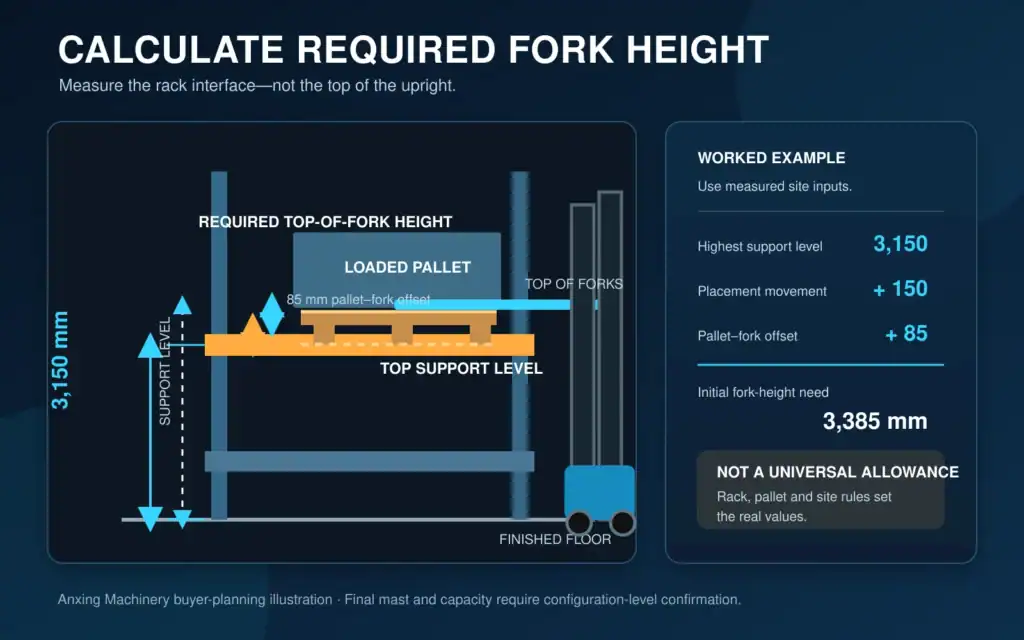
The highest pallet-support level is a site measurement. Take it at the rack bay the truck will actually serve, from the floor beneath the machine to the top of the supporting surface. If the floor changes level along the aisle, survey the least favorable combination rather than relying on the rack installer’s nominal drawing.
Placement movement is the vertical distance needed to raise the pallet clear of the support before entering or withdrawing. It is not a universal allowance. Rack design, pallet deflection, beam or rail profile, floor condition, operator procedure and the warehouse’s own clearance rules all affect it. Ask the rack supplier or responsible site engineer to define the required movement for the storage system instead of copying a figure from an unrelated installation.
The pallet-to-fork interface offset is often missed. When the pallet is carried, the top of the forks may sit above the pallet’s lowest bearing surface. Bottom boards, blocks, moulded feet and fork-entry tunnels change that relationship. Measure the vertical distance from the lowest part that must clear the rack support to the top surface of a fully inserted fork, using a representative pallet or an accurate underside drawing.
Consider a worked example, not a general specification. The top support level is measured at 3,150 mm. The site has established that the pallet must rise 150 mm above that support for placement, and the measured pallet-to-fork offset is 85 mm. The initial requirement is therefore 3,385 mm. A 3,500 mm lift configuration enters the shortlist, with 115 mm of nominal travel remaining. That last 115 mm should not be treated as a guarantee: floor tolerance, mast definition, pallet variation and capacity at height still belong in the supplier’s review.
If the calculation reaches 3,500 mm exactly, specifying a 3,500 mm truck is poor procurement. It leaves the operator trying to place the pallet at the mechanical limit and gives no room for real-world variation. There is no single percentage or fixed margin that suits every rack. The sensible margin is the one supported by the measured installation, the rack interface, the operating method and the exact mast data.
Four Mast Dimensions Must Agree
Maximum fork height answers only “can the forks reach?” A usable mast configuration also has to enter the building and extend within the available overhead space. Put these four dimensions on the same review sheet:
- Maximum fork height: the highest specified position of the forks. Compare it with the calculated requirement, not simply the beam elevation.
- Overall lowered mast height: the truck’s height with the mast collapsed and the forks lowered. Compare it with doors, mezzanines, low cross-members and any confined route.
- Overall raised mast height: the highest point of the mast or load backrest at full extension. Compare it with ceilings, sprinklers, ducts, lights and rack-area obstructions.
- Free lift: how far the forks can rise before the mast sections extend above the lowered mast envelope. It becomes important inside trailers, containers or rooms with restricted overhead clearance.
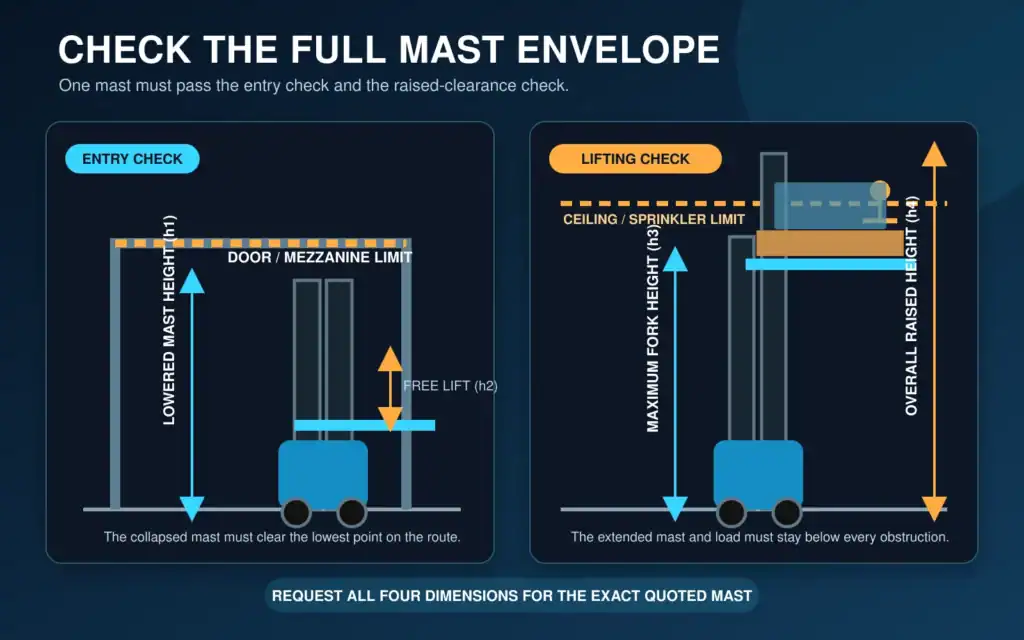
These dimensions change with the mast, even when the rated capacity and chassis look similar. A taller mast may solve the rack calculation but fail at a doorway. A full-free-lift arrangement may solve work in a confined area while changing mast complexity, visibility, weight or cost. The quotation should identify the selected mast and its dimensions rather than describing it only as “3.5 m” or “6 m.”
The Top Level Must Be Checked for Load, Not Reach Alone
A truck that can raise empty forks to the required level is not necessarily approved to place the heaviest pallet there. Rated capacity belongs to defined conditions, including load center and configuration. As the load moves higher or its center of gravity moves farther forward, the permitted load may be lower than the headline rating.
Give the supplier the complete pallet weight, including the pallet, packaging, dunnage and fixtures. Also provide load depth along the forks, overhang and any uneven weight distribution. Then ask a specific question: What is the permitted load for this quoted mast at our required fork height and actual load center? The answer should refer to the final configuration, not to another truck in the same series.
This is where lift height and capacity selection meet. A 2,000 kg stacker does not automatically place 2,000 kg at its maximum lift, and choosing a 3,000 kg nominal class does not correct an unsuitable pallet, aisle or mast. The related 1.5 ton versus 2 ton stacker capacity guide explains the load side of that decision in more detail.
When 3.5 m Is Enough—and When to Investigate a Higher Mast
| Decision point | 3.5 m configuration | Higher-lift configuration | Evidence needed |
|---|---|---|---|
| Calculated fork height | A candidate when the full calculation remains below 3,500 mm with a defensible operating margin | Investigate when the calculation approaches or exceeds 3,500 mm | Support level, placement movement, pallet interface offset and floor survey |
| Capacity at the top level | Must carry the complete load at the required height and load center | Must also be verified; extra reach is not a capacity promise | Configuration-specific capacity information |
| Door and route clearance | Often easier to package, but the quoted lowered mast height still governs | A taller or multi-stage mast may be required to combine reach with entry clearance | Lowest doorway, beam, mezzanine and confined-space height |
| Overhead space while lifting | Compare the raised mast and load envelope with every obstruction | More critical as mast extension increases | Ceiling plan plus sprinklers, lights, ducts and rack obstructions |
| Operating pattern | Can suit short, intermittent rack work when a pedestrian format matches the route | Repeated travel or higher racking may support a stand-on configuration | Distance per cycle, cycles per shift, stops and traffic layout |
| Future rack changes | A disciplined choice when the present and planned top levels are known | Useful only when the additional height is part of a credible layout plan | Approved expansion drawing, not a vague request to “allow for growth” |
Buying the tallest mast available can increase cost and may alter lowered height, extended height, visibility, operating weight and residual capacity. It can also push a project into a different operating format. Additional reach should solve a documented storage requirement.
Apply the Calculation to Current Anxing Stacker Series
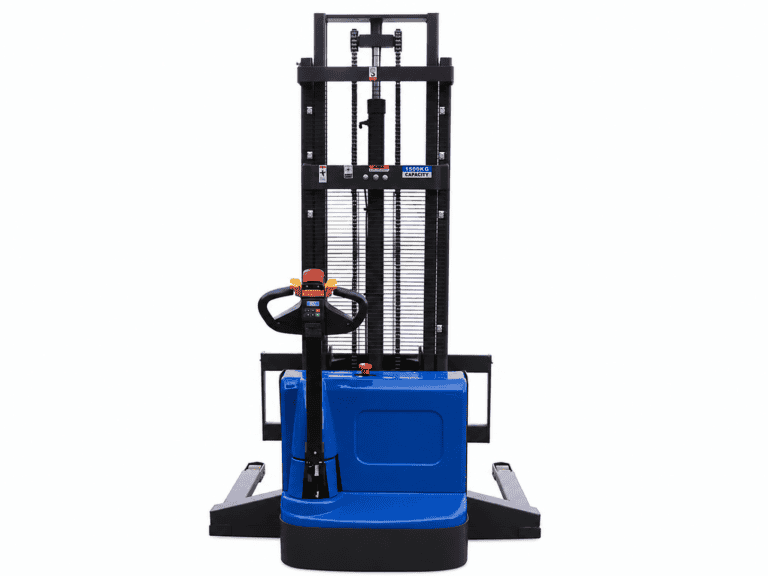
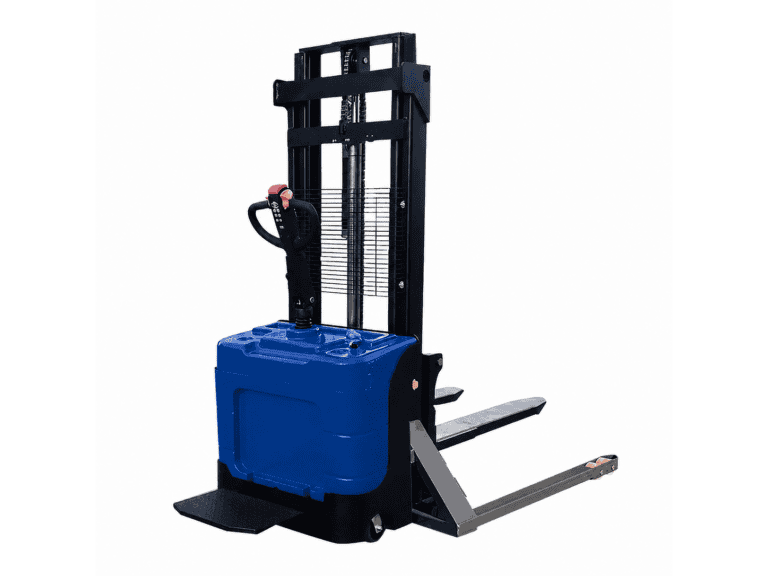
Anxing’s current CDD-1.5T-2T walkie electric pallet stacker is published with configurable rated capacities from 1,500 to 2,000 kg and a 3,500 mm lift height. It is the natural series to investigate when the measured fork-height requirement fits within that range and the job favors short-distance pedestrian operation. The page lists an overall width of 790–850 mm and a turning radius of 1,688 mm, depending on configuration, but those chassis figures do not replace a loaded working-aisle check.
For higher racking or travel-intensive work, the current CDD-15-30 stand-on electric pallet stacker series covers configurable rated capacities from 1,500 to 3,000 kg and lift configurations from 3,500 to 6,000 mm. Its mast is described as customizable according to lift height and site clearance, and the overall height depends on the selected mast. This is precisely why a request for “the 6 m model” is incomplete: Anxing still needs the required fork height, lowered and raised clearances, load center and top-level load.
The two ranges can be compared on the current Anxing electric stacker category page. Use their published values to form a shortlist, then freeze the mast and capacity conditions in the quotation. If pallet underside, operator format, battery duty and route are still open questions, the broader electric pallet stacker buying guide provides the next screening layer.
A Six-Step Lift-Height Survey Before You Request a Quote
- Identify the highest real storage position. Mark the bay and level on the layout. Measure from the finished wheel path to the top of the beam, rail, cart or other pallet support.
- Record the pallet interface. Photograph the underside, mark the fork-entry direction and measure the offset from the lowest bearing surface to the top of the inserted forks. Include the worst regular pallet, not only a new empty sample.
- Define placement movement. Obtain the vertical movement needed to clear the support from the rack supplier or responsible site engineer. Consider pallet deflection, rail profile and the operating method.
- Survey the entire mast envelope. Measure the lowest doorway and overhead route restriction, then map ceiling fixtures and obstructions where the mast will extend. State any free-lift requirement separately.
- Pair height with the heaviest complete load. Provide weight, load depth, center of gravity and overhang. Require capacity confirmation at the calculated fork height for the quoted mast.
- Review the rest of the route before approving the mast. Check pallet fit, right-angle stacking aisle, rack approach, floor condition, gradients, duty cycle and charging. A correct vertical calculation cannot rescue a truck that cannot reach or turn into the bay.
Keep the measurements on one dimensioned sketch. Photos are valuable, but perspective makes them poor substitutes for dimensions. A marked elevation of the rack, a simple route plan and a pallet underside drawing usually give a supplier more decision value than a long equipment wish list.
Cases Where the Simple Calculation Needs More Review
Several rack systems share one truck. Calculate each support type separately. The highest beam may not create the greatest fork requirement if another system has carts, rails or a pallet geometry that adds more interface offset.
The floor is not consistent. A nominally level rack drawing does not show slab falls, joints or settlement. High stacking also makes floor condition more important to positioning and stability. Record deviations and let the equipment and rack specialists review the application; do not compensate by improvising extra mast travel.
The warehouse expects a future top level. Size against an approved proposed layout, including beam elevations, load dimensions, sprinkler and ceiling clearances, aisle and rack capacity. Buying unused mast height for an undefined expansion can add tradeoffs today without guaranteeing that tomorrow’s rack will be compatible.
The load changes between levels. The highest load may not be the heaviest load. Create a small load-by-level matrix: complete weight, load depth, pallet type and required fork height for every demanding combination. The configuration must cover the worst credible combination, not separate maximum figures that never occur together.
What Anxing Needs to Confirm the Mast
Send the highest support elevation, the calculated fork-height components and clear photos or drawings of the rack and pallet underside. Add the minimum door and overhead heights, ceiling-obstruction plan, required free lift, heaviest complete pallet, load dimensions and center-of-gravity information. The route plan should show aisle widths, cross aisles, floor transitions and gradients.
For the commercial configuration, include cycles per hour, travel distance, shifts, charging windows, local electrical supply, quantity and destination. Ask the quotation to identify the exact mast, maximum fork height, lowered and raised mast dimensions, free lift, permitted capacity at the specified height and the final truck dimensions. This turns “3.5 m or 6 m?” into a configuration that purchasing, warehouse operations and the supplier can all review against the same drawing.
Choose the Shortest Verified Mast That Covers the Job
The right lift height is the lowest mast configuration that reaches the calculated fork position with a justified working margin, carries the complete load there and fits the building in both collapsed and extended states. Measure the support level and pallet interface first. Once those numbers are tied to capacity at height, doors, overhead space and the actual route, the choice between a 3.5 m stacker and a higher-lift configuration becomes a technical decision rather than a brochure comparison.