
Key Takeaways
- Choose a 1.5 ton electric pallet stacker when the heaviest complete pallet, actual load center and required lift height remain within the final machine’s documented capacity. Choose a 2 ton configuration when loads exceed or repeatedly approach 1,500 kg, or when deeper or uneven loads require a higher-capacity review. A 2 ton rating does not automatically mean the machine can place 2,000 kg at maximum height.
The 500 kg difference looks simple, but packaging, pallet weight, overhang and an off-center load can change the requirement. A 2 ton label also does not prove that the stacker can place 2,000 kg at maximum height.
Rated Capacity Is Not the Same as Usable Capacity
Rated capacity is the nominal load under defined conditions, including a stated load center and equipment configuration. Residual capacity is the permitted load under the buyer’s actual conditions, especially at a specific height and load center.
This prevents buying a 1.5 ton stacker for a load described as “about 1.5 tons” without weighing the complete pallet, or assuming a 2 ton model retains its full nominal capacity at the top rack.
The broader electric pallet stacker buying guide explains how capacity, height and pallet type work together. For this comparison, the important starting point is that a higher nominal rating creates a different capacity class; it does not remove the need for application-specific verification.
Calculate the Maximum Complete Pallet Weight
Use the heaviest credible load, not the monthly average. Review receiving records, production batches and seasonal peaks, then include every component lifted by the forks:
- product or material;
- pallet, stillage, bin or cage;
- cartons, wrapping, dunnage and protective materials;
- any fixture or removable handling frame;
- credible variation caused by moisture, fill level or batch tolerance.
If a product batch weighs 1,420 kg and the pallet plus packaging adds 80 kg, the complete load already reaches 1,500 kg. That does not create operating clearance for a 1.5 ton machine, and it still says nothing about capacity at height. A verified 2 ton configuration becomes the logical class to investigate. By contrast, a well-controlled 1,100 kg complete pallet should not automatically require a 2 ton stacker merely because “more capacity is better.”
Do not apply one universal percentage buffer. Document weight uncertainty, load geometry, height and equipment changes; if incoming pallets vary, record the highest accepted weight and how it is verified.
Check Load Center and Weight Distribution
The load center is the horizontal distance from the fork face to the load’s center of gravity. For a uniformly distributed load, it is often near half the load depth measured along the forks. Real loads may not be uniform. A motor, die, liquid container or overhanging product can place the center of gravity farther forward.
A simple load-moment calculation is useful for screening: multiply load weight by the horizontal load-center distance. For example, 1,300 kg at a 600 mm load center creates a screening moment of 780,000 kg-mm, which is greater than 1,500 kg at 500 mm, or 750,000 kg-mm. This does not authorize either load. It demonstrates why a lighter but deeper load can be more demanding than a heavier compact one. The exact capacity plate or manufacturer-supplied chart for the final stacker must govern the decision.
Send a dimensioned load drawing when the center of gravity is offset, difficult to identify or changes between products. Also state any product overhang and the required fork length, because longer forks or changed load position can affect the final review.
1.5 Ton vs. 2 Ton Electric Pallet Stacker Comparison
| Decision factor | 1.5 ton configuration | 2 ton configuration | Required confirmation |
|---|---|---|---|
| Nominal rated capacity | 1,500 kg under defined rating conditions | 2,000 kg under defined rating conditions | Exact rating conditions and capacity information |
| Maximum complete pallet | Candidate only when every credible load fits the confirmed operating envelope | First class to investigate when loads exceed or repeatedly approach 1,500 kg | Verified peak weight including pallet and packaging |
| Load geometry | May suit compact, evenly distributed loads within the stated load center | Provides a higher nominal class but does not automatically approve deep or offset loads | Load depth, center of gravity, overhang and fork requirement |
| Capacity at height | Must cover the actual load at the highest placement point | Also requires residual-capacity confirmation; nominal rating is not a top-height promise | Mast, target fork height, load center and applicable capacity chart |
| Space and machine size | May be the more compact configuration within some product series | May change width, weight or other dimensions depending on design | Quoted dimensions and working aisle with the actual pallet |
| Duty cycle | Suitable only when capacity and battery duty both match the work | Higher load rating alone does not guarantee longer runtime or higher throughput | Loads per hour, travel distance, lift cycles, shifts and charging windows |
| Purchase decision | Avoid paying for unused capacity when the load envelope is controlled | Avoid underspecifying when heavier pallets are part of normal or credible peak work | Like-for-like mast, battery, charger, forks, wheels and delivered scope |
The table does not promise that a 1.5 ton unit is always smaller or a 2 ton unit more productive. Compare exact configurations. Operating format is a separate choice; the walkie vs. stand-on pallet stacker guide covers route length, stop frequency and traffic conditions.
Confirm Capacity at the Highest Placement Point
Measure the highest rack support level, then add the pallet base and practical fork clearance. Also record the lowest overhead obstruction along the route so the selected mast can pass.
Ask the supplier a precise question: “What load is the quoted machine permitted to handle at our required fork height and actual load center?” Provide the mast, forks and attachment requirements with that question. If the answer is lower than the complete pallet weight, moving from 1.5 ton to 2 ton may be one possible solution, but it is not the only one. The mast arrangement, load position or equipment class may also need to change.
Apply the Decision to Verified Anxing Models
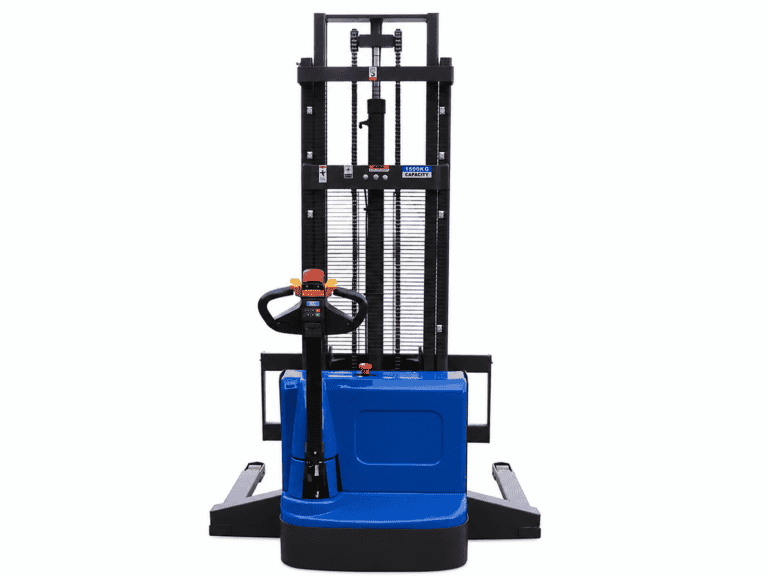
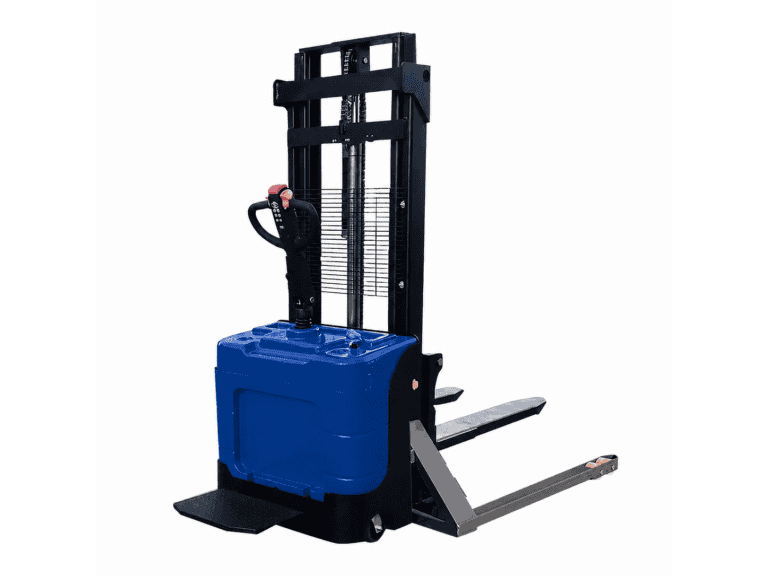
Anxing’s current CDD-1.5T-2T walkie electric pallet stacker offers configurable rated capacities from 1,500 to 2,000 kg with a listed 3,500 mm lift height. The published series data lists a 1,688 mm turning radius, overall length of 1,850–1,970 mm and overall width of 790–850 mm, depending on configuration. Fork dimensions and the overall configuration can be matched to the pallet-handling application.
For operations that justify a rider platform or require more vertical reach, the CDD-15-30 stand-on electric pallet stacker series covers configurable rated capacities from 1,500 to 3,000 kg and published lift options from 3,500 to 6,000 mm. Its product page identifies 1.5 ton and 2 ton configurations at 3.5 m, plus higher-lift 2 ton configurations. Capacity at maximum height is not necessarily the nominal capacity, so residual-capacity data must be confirmed for the selected mast.
These figures help build a shortlist, but they do not approve a warehouse application. Use the current Anxing electric stacker range to compare the product classes, then request a configuration sheet tied to the real load and route.
Four Practical Selection Examples
Controlled 1,100 kg pallets at moderate height
A warehouse handles uniformly loaded 1,100 kg complete pallets and has reliable weight records. A 1.5 ton configuration is the sensible starting point if its capacity at the required height, pallet fit and aisle requirement are confirmed. A 2 ton rating alone would not solve any identified constraint.
Product is 1,450 kg before packaging
If 1,450 kg describes only the goods, the pallet, wrapping and fixture can take the complete load to or above 1,500 kg. A 2 ton configuration should be investigated, followed by residual-capacity confirmation at the target height.
Long or uneven 1,300 kg loads
A 1,300 kg load may still require a higher-capacity or different equipment review when its center of gravity sits far forward. Do not approve the 1.5 ton model from weight alone. Supply a drawing and center-of-gravity information.
Mixed warehouse with occasional 1,700 kg pallets
If the same stacker is expected to handle credible 1,700 kg loads, a 1.5 ton unit cannot cover the complete work scope. A verified 2 ton configuration is the minimum capacity class to investigate. Alternatively, separate the heavy-load task and select different equipment for that route.
Seven-Step Capacity Selection Workflow
- List every load family. Record product, pallet and packaging weight separately.
- Identify the peak complete weight. Use credible receiving or production variation, not an average.
- Measure load geometry. Provide depth along the forks, width, height, overhang and center-of-gravity information.
- Define the placement height. Record the highest support level, pallet height, clearance and overhead restrictions.
- Check pallet compatibility. Photograph the underside and measure entry openings, bottom boards and intended fork direction.
- Compare complete configurations. Review capacity at height, working aisle, mast, forks, battery, charger, wheels and operator format.
- Approve documented limits. Confirm the final quotation, capacity information and operating documentation before normal use.
What to Send with Your RFQ
- maximum and typical complete pallet weights;
- load dimensions, weight distribution and center of gravity;
- pallet dimensions, underside photographs and entry direction;
- highest required fork elevation and lowest overhead clearance;
- narrowest clear aisle, cross aisle, doors and turning points;
- cycles per hour, travel distance, shifts and charging windows;
- floor condition, thresholds, dock plates and gradients;
- required forks, attachments, quantity and destination.
The Right Choice Is the Smallest Verified Capacity That Covers the Full Job
A 1.5 ton electric pallet stacker is the right choice when measured peak loads, load center and required height all fall within the final machine’s documented capacity. A 2 ton stacker is the better class to investigate when complete pallets exceed or repeatedly approach 1,500 kg, or when the load envelope demands more capacity. The extra 500 kg should solve a documented requirement, not serve as a substitute for measuring the load.
Compare both capacities with the same mast, pallet, aisle, battery and operator-format assumptions. This reduces the risk of paying for unused capacity or underspecifying the machine.