Key Takeaways
- Choose a walkie electric pallet stacker for short, intermittent or stop-rich pallet moves where compact operation matters more than ride-on travel. Choose a stand-on stacker when repeated travel creates substantial operator walking and the route can accommodate the platform configuration. Confirm the decision against the actual pallet underside, load at height, working aisle, floor conditions, traffic plan and battery duty.
Both formats can lift and stack pallets, but they organize the operator’s work differently. That difference affects labor time, fatigue exposure, traffic interaction and the space needed to turn. Buyers should therefore compare walkie and stand-on machines against the same load and duty sheet—not simply order the format that looks faster or costs less.
What Do “Walkie” and “Stand-On” Mean?
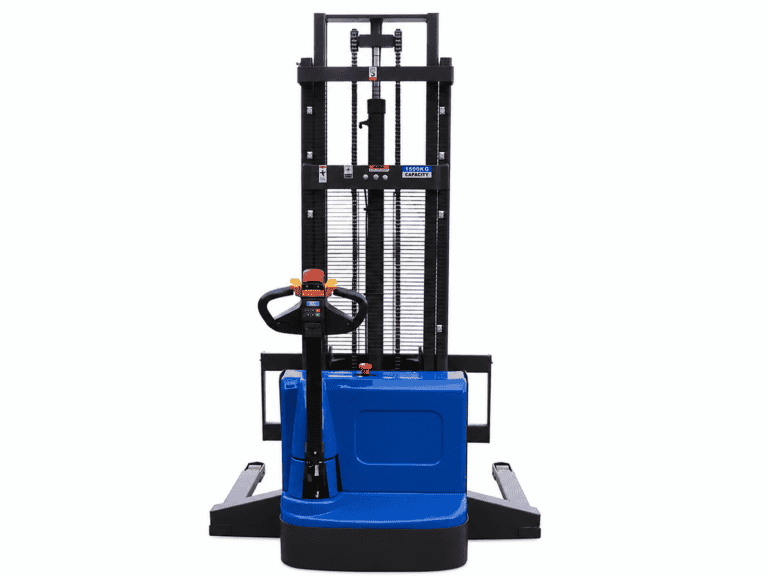
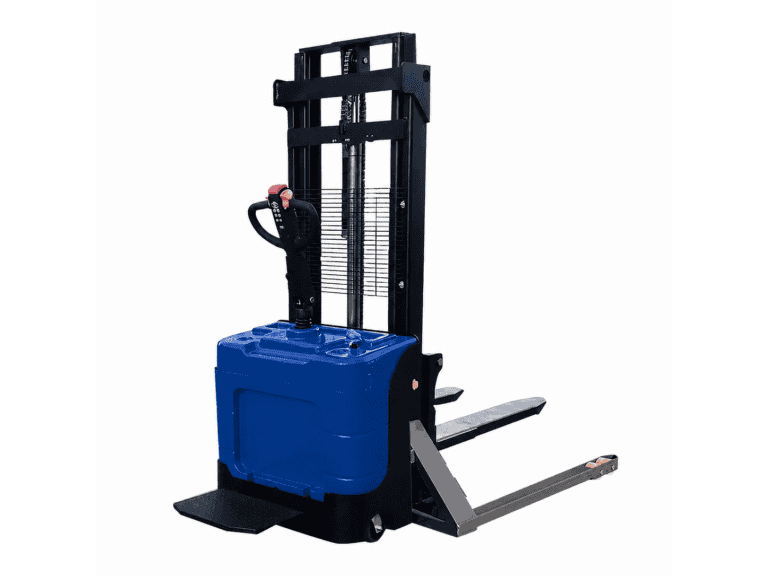
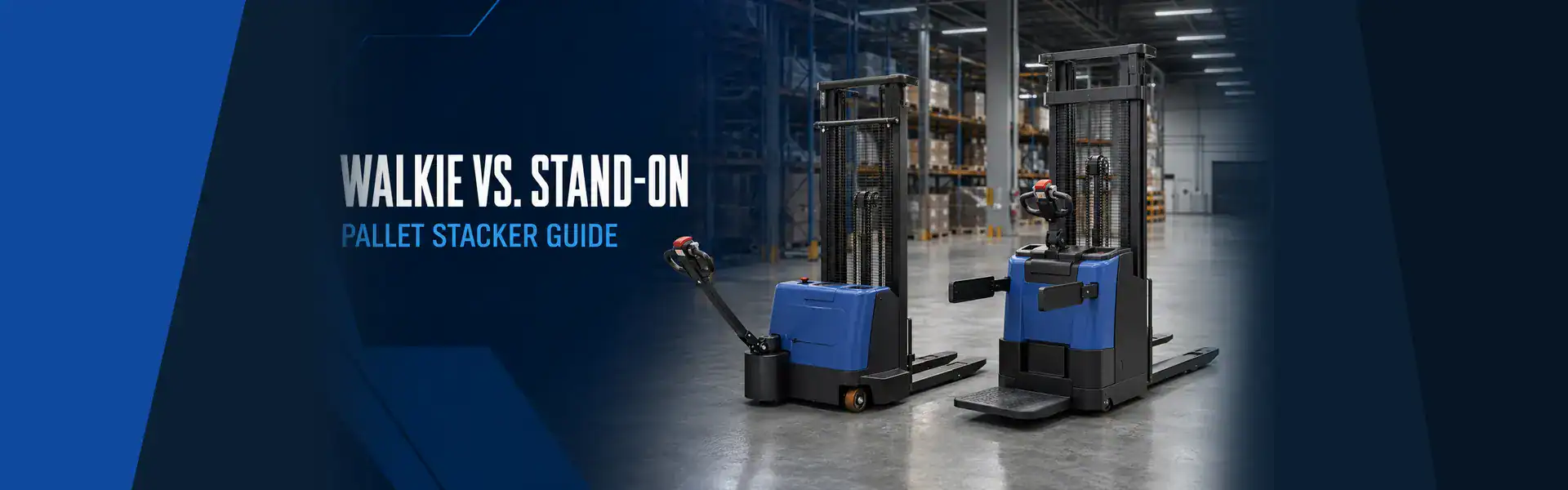
A walkie stacker, also called a pedestrian or walk-behind stacker, is controlled through a tiller while the operator walks with the machine. It has powered travel and powered lifting but no normal riding position. The absence of a platform can make this format a practical starting point for short transfers, occasional replenishment and compact storage areas.
A stand-on stacker, sometimes described as a platform or rider stacker, gives the operator a place to ride during travel. Platform arrangements vary: some are fixed within the chassis, while others fold when not required. The benefit is not the label itself; it is the ability to reduce repeated walking on travel-intensive routes. Platform position, guards and chassis geometry can also change overall length and the machine’s working envelope.
Do not confuse either machine with an electric pallet truck. A pallet truck mainly transports pallets near floor level. A pallet stacker has a mast and is selected to raise loads into racking or onto elevated storage positions. Buyers who still need to determine capacity, pallet entry and mast requirements should first use the broader electric pallet stacker buying guide.
Walkie vs. Stand-On Pallet Stacker at a Glance
| Decision factor | Walkie stacker | Stand-on stacker | What the buyer should verify |
|---|---|---|---|
| Operator position | Walks beside or behind the machine | Rides on an integrated or foldable platform | Control layout, approved operating position and operator procedures |
| Best starting use case | Short, intermittent transfers with frequent stops | Repeated transfers where travel occupies a substantial share of the shift | Distance per cycle, loaded cycles per shift and empty return travel |
| Walking workload | Increases with route length and frequency | Reduced during ride-on travel | Actual operator travel over a normal and peak shift |
| Stop-start work | Convenient where the operator repeatedly steps away for scanning, checking or handling tasks | Benefit can narrow if the operator mounts and dismounts at every very short move | Stops per cycle and time spent off the machine |
| Space and turning | Often the simpler compact format | Platform configuration can affect length and swept path | Model-specific working aisle with the real pallet—not width alone |
| Traffic interaction | Pedestrian operator travels with the machine | Riding position changes approach speed, sightlines and separation needs | Blind corners, crossings, rack ends and the site traffic plan |
| Purchase comparison | Can be economical when riding capability would add little cycle value | Can justify more equipment cost when saved travel time is repeatable | Equivalent mast, battery, charger, forks, options and delivered scope |
These are format-level tendencies, not guaranteed specifications. A particular stand-on model may have a compact turning radius, and a particular walkie may be longer than expected because of its mast, battery compartment or fork configuration. Final approval must use the quoted machine’s dimensions, capacity information and operating documentation.
Choose by Travel Workload, Not a Generic Distance Rule
Online comparisons sometimes say that a rider machine becomes necessary beyond one stated route length. That shortcut ignores frequency. A 25-metre route performed four times a shift is a different job from the same route performed 60 times. It also ignores the return leg: the operator normally travels both loaded and empty during a complete cycle.
Start with a simple workload measure:
Travel distance per shift = complete-cycle travel distance × loaded cycles per shift.
Map the route from pallet pickup through placement and back to the next pickup position. Include staging detours, door approaches and empty returns. Then observe where time is actually spent. If walking is only a small part of a cycle dominated by scanning, wrapping, inspecting or careful high-level placement, a stand-on format may deliver less benefit than expected. If the operator repeatedly crosses a long clear transfer lane between production, storage and dispatch, riding can remove a recurring non-value-added walk.
Use both a normal day and a peak day. A machine sized only around the average may become a bottleneck during receiving peaks, production changeovers or dispatch windows. If volume is expected to grow, record the forecast cycle count separately instead of hiding it inside a vague request for “high efficiency.”
When a Walkie Electric Pallet Stacker Is the Better Fit
A walkie stacker is usually the stronger first candidate when the warehouse handles short movements near a rack, production cell or loading area. It also fits stop-rich processes in which the operator scans a location, checks paperwork, opens a gate or performs another task after almost every move. In this pattern, immediate walk-up control can be more useful than a riding position.
Compact areas are another common reason. A rider platform may add length or alter the operator’s path at rack ends and doors. However, do not assume a walkie fits merely because its overall width is small. Right-angle stacking requires space for the chassis, mast, forks, support legs, pallet and load to sweep through the turn. Ask for working-aisle information for the selected pallet orientation and confirm the tightest cross aisle, not only the straight rack aisle.
A walkie can also be a disciplined investment when utilization is genuinely intermittent. Paying for a ride-on format does not create value if the unit spends most of the shift parked and its transfers remain short. Review Anxing’s current 1.5–2 ton walkie electric pallet stacker as a model-class example, then match the exact capacity, forks and dimensions to the application.
When a Stand-On Electric Pallet Stacker Is the Better Fit
A stand-on stacker becomes compelling when the same operator completes repeated pallet transfers and the rideable portion of the route is long enough to matter across the shift. Typical candidates include replenishment between bulk and pick faces, production feeding from a central store, and transfers between receiving, staging and storage. The strongest business case is measurable: riding reduces recurring travel time or walking burden without creating a new space or traffic problem.
Do not translate “stand-on” into “automatically higher throughput.” Travel speed, acceleration, braking, cornering rules, congestion and placement time all affect the cycle. On a very short route with a stop at each end, mounting and dismounting can consume part of the theoretical gain. A controlled time study with the shortlisted configuration is more useful than a class-level speed claim.
The rider position also needs a route review. Confirm sightlines around the mast and load, pedestrian separation, blind intersections, dock edges, doors and emergency procedures. Check whether a foldable platform may be used in each approved mode and how its position changes the quoted dimensions. Anxing’s current 1.5–3 ton stand-on electric pallet stacker series is the relevant range to investigate for repeated travel and higher-lift options.
Five Technical Checks That Can Override the Operator Format
1. Pallet underside and support-leg clearance
A stacker can have the right capacity and still be unable to engage the pallet. Photograph the underside and record entry direction, fork-pocket height and width, bottom boards, blocks or stringers. Many stackers have support legs that extend into or around the pallet footprint. The forks may align while those legs strike a bottom board. Closed-bottom pallets may require a different leg arrangement or equipment class. Verify every pallet family, including damaged or sagging examples.
2. Capacity at the required height
Rated capacity is conditional on load center and configuration. Ask for permitted capacity at the highest placement level with the actual load depth, mast, forks and any attachment. A 2,000 kg headline rating does not prove that every 2,000 kg load can be placed at maximum lift. Record the complete load weight, including the pallet, packaging, fixture and overhang.
3. Working aisle and route geometry
Turning radius and overall width are inputs, not a complete aisle approval. The load adds length and width to the swept envelope, while rack guards, pallet overhang and normal positioning clearance reduce usable space. Measure the narrowest clear route, cross aisles, rack-end turns, doors, columns and charging access. If the supplier does not publish a working-aisle figure for the relevant pallet, request a configuration-specific review or controlled fit check.
4. Floor, thresholds and gradients
Conventional warehouse stackers are generally evaluated for firm, level floors. Broken slabs, large joints, dock plates, drains, thresholds and ramps affect traction, ground clearance, braking and load stability. Provide the direction and percentage of every gradient. A published gradeability value is not permission to turn, park or lift on a slope; the machine’s limits, operating instructions and workplace controls govern use.
5. Battery, charger and shift pattern
Battery selection should follow travel, lift cycles, load, ambient temperature and charging windows. Request the chemistry, voltage, capacity, connector, charger input and charging routine for the final configuration. A stand-on machine used for repeated travel may have a different energy demand from a walkie used intermittently, but amp-hour figures alone cannot predict runtime. Include the destination site’s voltage, frequency and phase in the RFQ.
Verified Anxing Model Classes for Initial Shortlisting
| Published series | Operator format | Rated capacity | Lift height | Published width | Published turning radius |
|---|---|---|---|---|---|
| CDD-1.5T-2T | Walkie | 1,500–2,000 kg, configurable | 3,500 mm | 790–850 mm, depending on configuration | 1,688 mm |
| CDD-15-30 | Stand-on; foldable platform configuration available | 1,500–3,000 kg, configurable | 3,500–6,000 mm, customizable | 850–880 mm, depending on configuration | 1,530–1,688 mm, depending on configuration |
The table reflects Anxing’s currently published series data and is useful only for initial screening. It does not show residual capacity, working-aisle width with a defined pallet, free lift, lowered mast height or final battery duty. It also must not be read as proof that the stand-on series always turns within less space: its radius values belong to different configurations, and turning radius is not the complete right-angle stacking requirement. Use the electric stackers range to compare the current product classes, then request the specification for the exact quoted configuration.
How to Compare Cost Without Guessing at Productivity
Purchase price is only one line in a defensible comparison. Request both quotations with equivalent load capacity, mast, forks, leg arrangement, battery, charger, wheels, documents, spare parts and delivery terms. Otherwise, an apparent operator-format difference may actually be a difference in mast or battery scope.
Then time representative cycles with the real route or a controlled simulation. Separate travel time from pickup, positioning, lifting, scanning and other process time. Record the number of cycles completed, operator walking distance, interruptions, charging time and any extra maneuvering caused by platform position. Avoid converting a brochure’s maximum travel speed directly into annual savings; the machine rarely travels at that speed through every turn and shared aisle.
| Cost or workflow input | How to measure it | Why it matters |
|---|---|---|
| Delivered equipment scope | Compare the same mast, forks, battery, charger, wheels, options and documents | Prevents unrelated configuration differences from distorting price |
| Productive cycle time | Time complete pallet cycles under normal and peak conditions | Shows whether ride-on travel changes total throughput |
| Operator travel | Measure distance per cycle and cycles per shift | Quantifies the walking that a platform may remove |
| Energy and charging | Document operating hours, lifts, travel, breaks and available charging windows | Tests whether the supplied battery plan covers the duty |
| Space and traffic effects | Record corrections, waiting at crossings and any layout changes | Captures costs that a speed comparison misses |
| Planned service life | Use the buyer’s required years and annual shifts | Creates a common period for labor, maintenance and energy estimates |
Apply your own labor, energy, maintenance and financing rates to the measured results. If the stand-on configuration saves only a few seconds in a cycle that occurs occasionally, the business case may remain weak. If it removes a long repeated walk hundreds of times each week, the cumulative result can be material. Document the assumptions so a future volume change can be tested without restarting the comparison.
A Practical Eight-Step Selection Workflow
- Define every load. Record maximum weight, dimensions, load center, stability, packaging and overhang.
- Measure the pallet underside. Provide dimensions, entry direction, pocket openings, bottom boards and underside photographs.
- Map the complete cycle. Measure travel distance in both directions, loaded cycles, stops, lifts, shifts and peak periods.
- Survey the route. Record clear aisles, turns, doors, overhead restrictions, pedestrian crossings, floors and gradients.
- Compare operator formats. Shortlist walkie for compact or stop-rich work and stand-on for travel-intensive work, while keeping both where the evidence is mixed.
- Check hard technical limits. Confirm pallet and leg compatibility, capacity at height, mast clearance, working aisle and approved floor conditions.
- Request like-for-like quotations. Specify the exact mast, forks, battery, charger, wheels, options, documents, spares, quantity and destination.
- Validate before approval. Review the final specification and capacity information and, where practical, perform a controlled route or fit test under the buyer’s safety procedures.
This process may produce different answers inside one facility. A walkie stacker can serve compact rack replenishment while a stand-on unit handles longer transfers between receiving and storage. Dividing work by route can be more economical than forcing one machine to cover conflicting tasks. The warehouse material handling solution provides a broader framework for mapping equipment to each stage of the load flow.
What to Include in Your RFQ
- maximum and typical load weight, complete dimensions and load center;
- pallet size, underside photos, entry direction and opening dimensions;
- required lift height, highest pallet position, free-lift need and overhead limits;
- narrowest clear aisle, cross-aisle width, doors, turns and a route sketch;
- distance per complete cycle, cycles per hour, shifts, peak volume and stops;
- floor condition, joints, thresholds, dock plates, slopes and ambient environment;
- battery preference, charging windows and local voltage, frequency and phase;
- required forks, leg arrangement, wheels, options, manuals, documents and spare parts;
- order quantity and destination country, city or port.
Final Recommendation
For a walkie vs. stand-on pallet stacker decision, start with the work cycle. A walkie is normally the efficient choice for short, intermittent or stop-rich handling in compact areas. A stand-on machine is normally the stronger candidate when repeat travel creates significant walking and the route can safely accommodate the rider configuration. Neither answer overrides pallet fit, capacity at height, working aisle, floor suitability or battery duty.
The best purchase file contains measured loads, underside pallet photos, a dimensioned route, cycle counts and a like-for-like equipment scope. With that evidence, the supplier can recommend an exact configuration and the buyer can compare cost on repeatable operating results rather than assumptions.