Key Takeaways
- Choose an electric pallet stacker by the heaviest load at the highest required placement height, then verify the pallet underside, fork and support-leg fit, working aisle, route, duty cycle and charging plan. Do not treat rated capacity or maximum lift height as standalone approvals.
For many warehouses, the first shortlist is between a compact walkie stacker for shorter routes and a stand-on stacker for more frequent travel. That choice should come after measuring the loads, pallets, rack and route—not before. A 2-ton machine can be wrong for a 1.5-ton pallet if the load is unusually deep, the required stacking height reduces available capacity, or the pallet base prevents the stacker’s forks and legs from entering.
Start with Three Connected Buying Filters
Capacity, height and pallet type cannot be approved independently. Capacity is stated at defined conditions, including a load center. Height changes the stability and residual-capacity requirement. Pallet construction determines whether the machine can pick up the load at all. Treat these as one compatibility check:
| Selection filter | Measure or verify | Why the headline specification is insufficient | Supplier confirmation required |
|---|---|---|---|
| Capacity | Heaviest load, dimensions, weight distribution and load center | Rated capacity applies only under stated load-center and configuration conditions | Permitted capacity for the actual load and attachment configuration |
| Lift height | Top beam level, pallet height, placement clearance and lowest doorway | Maximum fork height does not show residual capacity or lowered mast clearance | Capacity at the required height plus raised and lowered mast dimensions |
| Pallet type | Overall size, fork-entry direction, opening height, deck arrangement and bottom boards | A pallet can fit the forks yet conflict with the stacker’s support legs | Fork and leg layout compatible with every pallet handled |
| Warehouse route | Aisles, right-angle turns, doors, ramps, floor condition and travel distance | Overall width alone does not prove that the machine can turn and position a load | Model-specific working-aisle and route suitability |
| Duty pattern | Loads per hour, travel distance, shifts, breaks and available power | Battery voltage or capacity alone does not predict performance in a real cycle | Battery, charger and operating format for the documented workload |
Capacity Means Load, Load Center and Height Together
Rated capacity is conditional
A stacker’s rated capacity is not a promise that it can lift any object of that weight. The rating is tied to the load center stated on the data plate or capacity information. A deeper load moves its center of gravity farther from the fork face and increases the overturning moment. Unevenly distributed goods, overhanging cartons, liquid loads and long components can also place the center of gravity somewhere other than the geometric middle.
Record the maximum actual load rather than using the average. Include the pallet, container, wrapping, dunnage and any handling fixture. Then measure the load dimension parallel to the forks and identify where the weight is concentrated. Do not approve a machine from a simplified load-moment calculation alone. Calculations can help reveal that a longer load needs review, but the model-specific data plate and manufacturer’s capacity information must govern the final decision.
Ask for residual capacity at the required height
The capacity needed at floor level is not the only relevant figure for racking. The supplier should confirm how much the quoted configuration is permitted to handle at the buyer’s highest placement height and actual load center. Mast type, lift height and load geometry can change the available capacity. If an application must place a 1,500 kg loaded pallet on the top beam, a machine advertised as “1.5 ton” should not be approved until its capacity at that height is documented.
Attachments or nonstandard forks also require configuration-specific confirmation. Do not assume that a capacity statement for the standard machine remains unchanged after adding equipment, changing fork dimensions or moving the load farther forward. The final quotation and capacity information should identify the approved configuration.
Specify the Required Height from the Rack Geometry
Start with the highest rack beam or support level where the pallet must be placed. Add the height of the pallet base and enough practical clearance to enter, position and withdraw the forks without contacting the rack. The required fork elevation is therefore not simply the clear ceiling height or the number written on the rack label.
Maximum lift height should provide useful operating margin, but buying the tallest available mast by default creates other tradeoffs. A higher mast can change lowered height, visibility, machine weight, residual capacity and cost. It may also prevent the stacker from passing under a door, mezzanine or other overhead restriction. Measure the lowest overhead point on the route and compare it with the exact mast-lowered dimension of the quoted model.
Free-lift requirements should be stated separately. If pallets must be raised inside a container, trailer or low-ceiling area, the buyer needs to know how far the forks can rise before the mast extends above its lowered height. Do not infer this capability from maximum lift height. Request the mast arrangement and free-lift figure for the exact configuration.
Pallet Type Can Decide Whether the Stacker Works
Before discussing power or travel speed, photograph and measure every pallet family in use. Include the underside, because that is where stacker compatibility is decided. Record the pallet’s length and width, the intended entry direction, fork-pocket height and width, center blocks or stringers, bottom boards and any damaged or sagging areas.
Fork-over and support-leg interference
Many stackers use load-bearing support legs extending ahead of the chassis. In a fork-over arrangement, the legs sit below the forks and must enter the pallet footprint. This generally requires suitable open space beneath the pallet. Closed-bottom or double-deck arrangements may block the legs even when the forks align with the entry openings.
A straddle arrangement places the support legs outside the pallet or load. It can address some closed-bottom pallet applications, but only when the inside distance, outside width and turning space suit the pallet and warehouse. Counterbalanced equipment keeps support legs out of the pallet area but changes machine dimensions, capacity behavior and aisle requirements. These are equipment classes, not interchangeable options that can be assumed from a product photo.
Do not rely on pallet names alone
Terms such as Euro pallet, block pallet, stringer pallet, two-way and four-way are useful descriptions, but pallets with the same label can differ by entry face, bottom-board arrangement or local construction. A nominal four-way pallet may accept forks from four sides yet still obstruct a particular support-leg layout. Use a dimensioned drawing or physical sample for final compatibility checking.
Also verify load overhang. Cartons or bags extending beyond the pallet can shift the load center, strike the mast or racking, and alter the turning envelope. Damaged boards can prevent clean entry or fail during handling. Pallet condition is therefore part of equipment selection and operating control, not merely a packaging issue.
Choose Walkie or Stand-On from the Travel Pattern
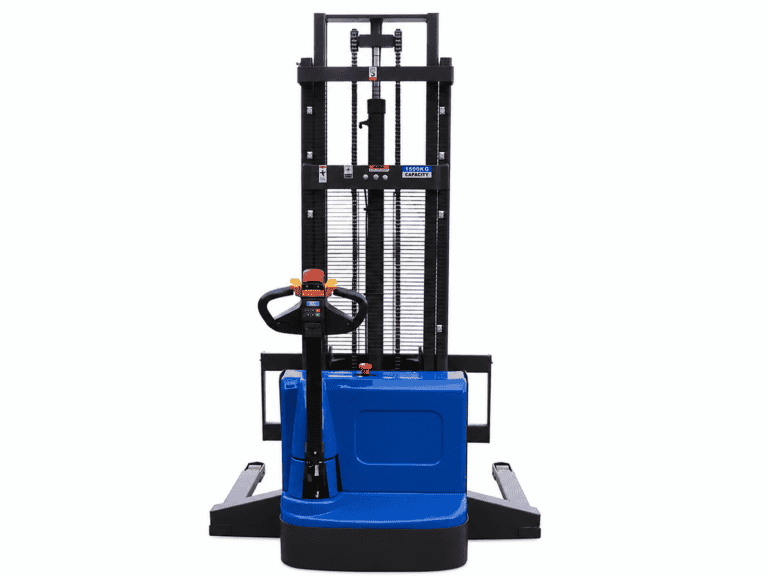
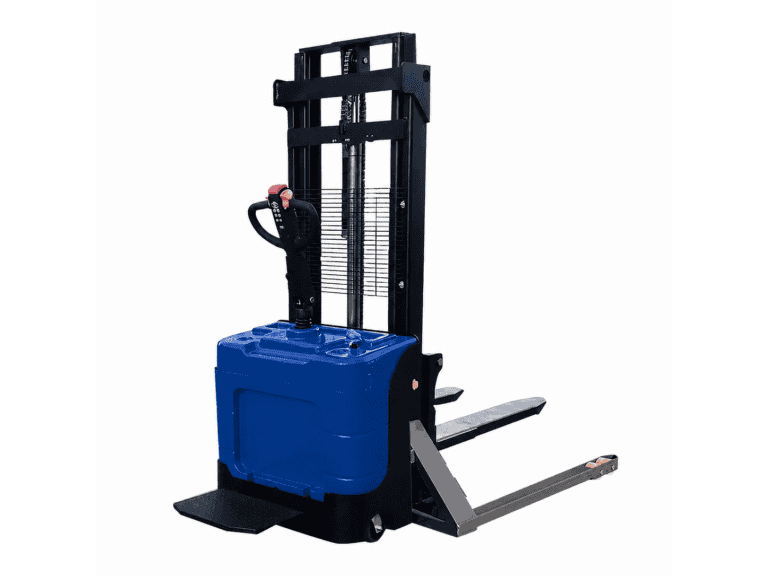
A walkie electric stacker is controlled by an operator walking with the machine. It is often the first format considered for shorter transport routes, lower cycle counts and compact areas where a rider platform is unnecessary. Anxing’s 1.5–2 ton walkie electric pallet stacker with a 3.5 m lift provides two capacity classes buyers can compare for this type of warehouse task.
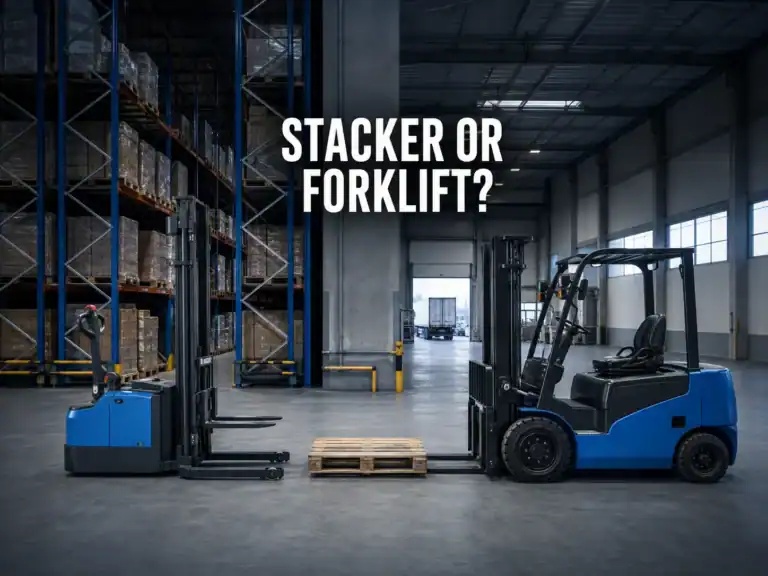
A stand-on stacker gives the operator a riding position and can be more suitable when repeated travel distance and throughput make walking inefficient. It is not automatically the better machine for every high-cycle site. The rider platform and protective structure can change length, turning behavior and required aisle space. Pedestrian traffic, route visibility, dock edges and operator procedures must also be considered.
Measure the full cycle: approach the pallet, engage it, reverse, travel, turn into the rack, raise, place, withdraw and return. Count cycles per hour and the distance traveled per cycle. This produces a more useful walkie-versus-stand-on decision than describing the warehouse as simply “small” or “busy.”
Verify the Entire Route and Placement Aisle
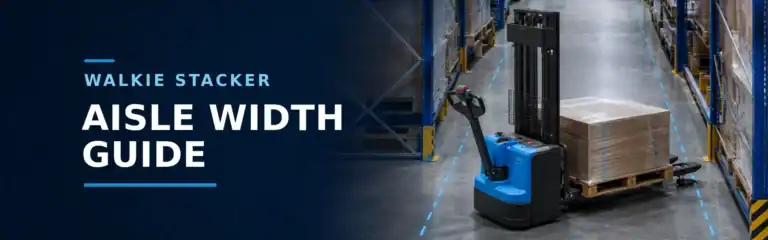
Overall machine width is only one access dimension. A stacker must pass through the narrowest opening while carrying the intended load, negotiate corners, and turn square to the rack with enough clearance for positioning. Obtain the model-specific working-aisle requirement for the actual pallet orientation. Do not substitute a chassis turning radius or unloaded overall width for a loaded right-angle stacking requirement.
Survey the route from unloading or charging area to every pickup and placement point. Record door width and height, rack upright spacing, cross aisles, blind corners, floor joints, drains, dock plates, gradients and pedestrian zones. Check whether the longest or widest load, rather than the pallet, controls the turning envelope.
Most conventional warehouse stackers are selected for firm, level floors. A ramp, broken slab, large threshold or outdoor yard can change traction, braking, ground clearance and stability requirements. State every gradient and surface transition in the RFQ. A published travel gradeability figure, if available, should not be interpreted as permission to raise a load on that gradient.
Match Battery and Charging to the Duty Cycle
Battery selection should begin with work performed per shift: travel distance, number of lifts, lift height, load weight, idle time, ambient conditions and available charging windows. Two sites with the same pallet weight can require different energy systems because one performs intermittent receiving work while the other feeds production continuously.
Ask the supplier to identify the battery chemistry, nominal voltage and capacity, charger input, estimated operating basis and charging procedure for the quoted configuration. Provide the destination voltage and frequency. If the equipment will work across multiple shifts, explain whether there is time for scheduled charging, whether opportunity charging is planned and how battery access or exchange would be managed. Do not select by amp-hour rating alone; machine efficiency, lift frequency and site conditions also affect usable runtime.
Operating environment matters. Cold rooms can affect battery performance and materials, while wet, dusty or corrosive areas may require a configuration specifically approved for those conditions. State the temperature range and environment in the inquiry instead of assuming that a standard warehouse unit is suitable.
How to Shortlist the Anxing Electric Stacker Range
Anxing’s published electric pallet stacker pages create three practical comparison steps. First choose walkie or stand-on operation from route length and cycle frequency. Then select the required rated-capacity class from the real load and load center. Finally compare the 3.5 m configurations with taller stand-on options when the rack requires more vertical reach.
| Published product class | Operator format | Published capacity | Published lift range | Use it to investigate |
|---|---|---|---|---|
| 1.5–2 ton walkie electric pallet stacker | Walk-behind | 1.5 or 2 ton | 3.5 m | Shorter warehouse routes where a walkie format suits the load and travel pattern |
| 1.5- or 2-ton stand-on electric pallet stacker | Stand-on | 1.5 or 2 ton | 3.5 m | Repeated travel where a rider format may improve the work cycle |
| 2-ton stand-on electric pallet stacker | Stand-on | 2 ton | Up to 6 m | Higher racking that requires configuration-level capacity and mast review |
| 3-ton stand-on electric pallet stacker | Stand-on | 3 ton | Up to 6 m | Heavier-load and higher-lift applications subject to route and residual-capacity confirmation |
These published figures are class filters, not final operating approvals. For example, the 2-ton stand-on stacker with lift configurations up to 6 m should be reviewed against the required capacity at the buyer’s exact height. The 3-ton stand-on electric pallet stacker range may provide a higher headline capacity, but the larger class still needs to fit the pallet, aisle, floor, battery routine and transport constraints.
A Practical Electric Pallet Stacker Selection Workflow
- List every load. Record maximum weight including pallet and packaging, dimensions in the fork direction, weight distribution and any overhang or instability.
- Measure every pallet from below. Photograph the underside and note entry direction, opening sizes, bottom boards, blocks and stringers.
- Map the rack geometry. Record the highest support level, pallet height, placement clearance, lowest overhead obstruction and any free-lift requirement.
- Calculate the operating cycle. Document trips per hour, travel distance, lifts, shift length, breaks and expected future volume.
- Survey the complete route. Measure doors, aisles, right-angle turns, cross aisles, floor transitions, ramps, dock plates and charging access.
- Choose the operating format. Compare walkie and stand-on configurations using travel distance, cycle frequency, traffic separation and available maneuvering space.
- Confirm pallet and leg compatibility. Match the measured underside to the fork, support-leg or straddle layout proposed by the supplier.
- Request capacity at height. Require model-specific confirmation for the maximum load, actual load center, target lift height and any changed forks or attachments.
- Size the battery routine. Provide the duty cycle, ambient conditions, destination electrical supply and charging windows for configuration review.
- Approve the quotation details. Confirm the exact model, mast, forks, leg arrangement, battery, charger, wheels, options, manuals, spare parts and destination documents.
Common Electric Pallet Stacker Buying Mistakes
Buying the exact nominal capacity of the heaviest pallet
This ignores load center, weight distribution, lift height and equipment configuration. Confirm permitted capacity for the real load at the real placement height.
Checking fork width but not the support legs
The forks may enter while the legs collide with bottom boards or pallet blocks. Review the full underside of the pallet against the proposed machine geometry.
Using rack height as the required lift height
The stacker needs enough fork elevation and clearance to place the pallet above its support level. Mast-lowered height and free lift may be equally important along the route.
Choosing stand-on operation only because it appears faster
Travel speed is one element of a complete cycle. A longer machine or rider platform may require more turning space, while traffic conditions and placement time can limit the expected gain.
Assuming an indoor stacker can cross any yard or ramp
Surface condition and gradients affect traction, clearance, braking and stability. Disclose every transition and use the machine only within its approved limits and site rules.
What to Include in an Electric Pallet Stacker RFQ
A useful RFQ lets the supplier check the application instead of returning a generic price for a “2-ton, 3.5-m stacker.” Send:
- maximum load weight including pallet and packaging;
- load dimensions, weight distribution and actual load center;
- pallet drawings or photos showing the underside and intended entry direction;
- required fork dimensions and any unusual loads or attachments;
- highest rack support level, required fork height and free-lift requirement;
- narrowest door, lowest overhead point and required right-angle stacking aisle;
- travel distance, cycles per hour, shifts and operating hours;
- floor type, joints, thresholds, dock plates, gradients and ambient conditions;
- walkie or stand-on preference and the reason for that preference;
- available voltage, frequency, charging windows and battery expectations;
- quantity, destination country, destination port or city, and unloading constraints;
- required manuals, markings, inspection, spare parts and documents to confirm.
Photos, a dimensioned pallet drawing and a simple warehouse route plan prevent many configuration errors. With these inputs, Anxing can compare the relevant capacity and mast classes, check whether walkie or stand-on operation fits the route, and identify the fork and support-leg arrangement that must be confirmed. The final selection should be based on the quoted configuration’s data plate, capacity information and operating manual together with the applicable destination and jobsite requirements.