Key Takeaways
- Choose an electric pallet stacker for compatible pallets, short repeatable indoor routes, level floors and compact rack areas. Choose an electric forklift when loads must travel farther, cross ramps or dock zones, use attachments, or move among mixed pallets and work areas. Compare the complete handling cycle—not capacity and lift height alone.
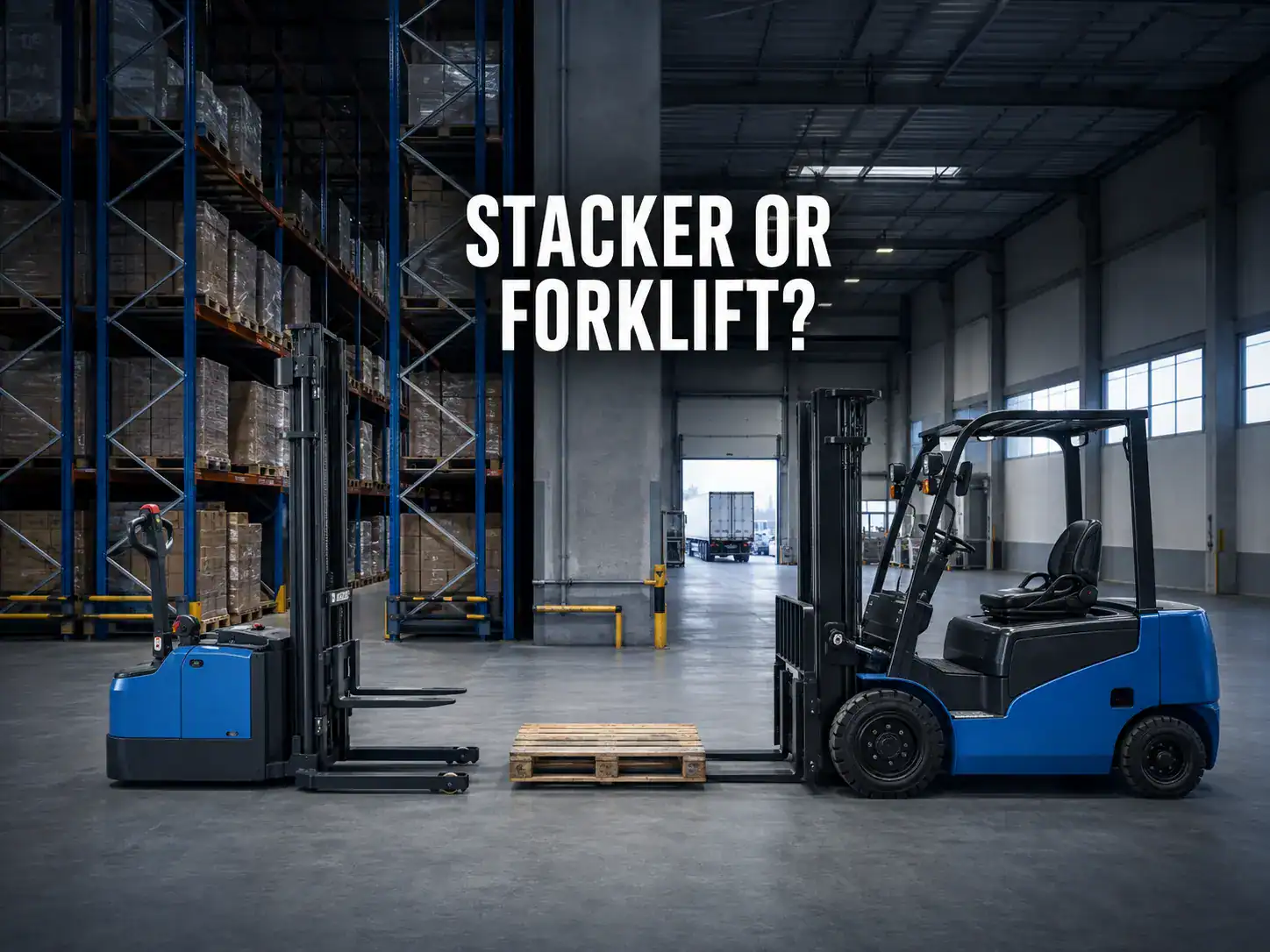
Choose an electric pallet stacker when the work is mainly compatible pallet handling over short, repeatable indoor routes and floor space is the main constraint. Choose an electric forklift when the truck must travel farther, work at a faster operating rhythm, handle a wider mix of loads, use attachments, cross ramps or dock areas, or move beyond the rack aisle into receiving and dispatch.
That answer is more useful than comparing capacity alone. A request for “2,000 kg and 3.5 metres” can describe either machine. The category becomes clear only after we follow one complete cycle: collect the pallet, reverse out, travel, turn, place it at height, withdraw, and return. The pallet base, rack, route and number of cycles all matter.
Both machines are electrically powered, so this is not an electric-versus-combustion decision. It is a choice between a compact warehouse truck built around a specific pallet flow and a counterbalanced truck with a broader operating envelope.
The Structural Difference Changes the Job
Most electric pallet stackers support the load with legs that extend beneath the forks or straddle the pallet. This allows a shorter, narrower chassis without the large rear counterweight used on a conventional forklift. It also creates the first selection question: where do those support legs go when the forks enter the pallet?
An open-bottom pallet may provide a clear path. A closed-bottom plastic pallet, a transverse board, or a rack floor rail may occupy the same space as the stacker legs. The forks can appear to fit while the machine still cannot reach the correct lifting position. This is why a pallet underside photo is more valuable to us than the description “standard pallet.”
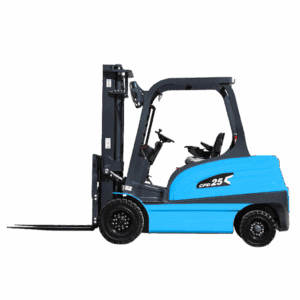
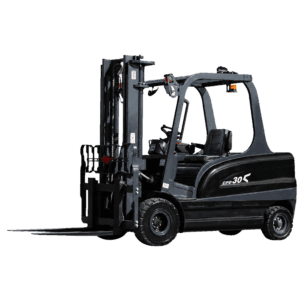
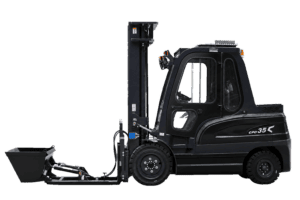
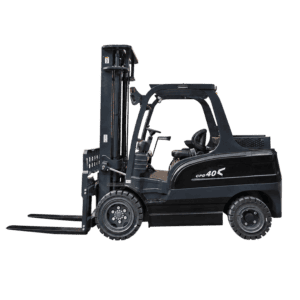
A counterbalanced electric forklift carries its balancing mass behind the mast. It does not need long support legs beneath or around the pallet, so it is less dependent on the pallet’s floor-level underside geometry. Fork openings, load support and stability still have to be correct, but the truck can approach a wider range of pallets, stillages and non-standard loads. The price for that flexibility is a longer, heavier machine with a larger turning envelope.
Electric Pallet Stacker vs. Electric Forklift at a Glance
| Decision factor | Electric pallet stacker | Electric forklift | What the buyer should verify |
|---|---|---|---|
| Primary role | Focused pallet transfer and rack stacking in a defined indoor area | Transport, stacking, loading and broader material handling across several work zones | The complete task, not only the highest lift |
| Load support | Usually uses support legs beneath or around the pallet | Uses a rear counterweight to balance the forward load | Pallet underside, fork entry, rack approach and load center |
| Operating space | Often shorter and narrower, making it attractive for compact storage areas | Needs more room for the chassis, counterweight and loaded turn | Model-specific working aisle with the actual pallet |
| Travel pattern | Best considered for shorter routes; walkie and stand-on formats serve different cycle lengths | Better suited to repeated travel across larger sites and between warehouse zones | Distance per cycle, cycles per hour, congestion and shift length |
| Load variety | Most effective with a controlled pallet pool and repeatable loads | More adaptable to mixed pallets, bins, long loads and approved attachments | Every regular load carrier, fork requirement and attachment |
| Floor and transitions | Favours firm, level warehouse floors and routes within the model’s approved limits | Offers more configuration choices for ramps, dock approaches and suitable indoor-outdoor transitions | Gradient, joints, dock plates, floor loading and tire configuration |
| Initial equipment cost | Usually the lower-cost category for a comparable basic pallet-stacking task | Higher investment may be justified by throughput and versatility | Delivered configuration, charger, maintenance, labor and lost time |
This is a category-level screen, not a specification sheet. A stand-on stacker can be very different from a compact walkie model, and a three-wheel electric forklift can turn more tightly than a larger four-wheel truck. Final fit comes from the quoted machine and the warehouse measurements.
Where an Electric Pallet Stacker Makes Sense
A stacker is often the cleaner answer in a small warehouse, packaging area, production supermarket or stockroom where the same few pallet types move between floor positions and lower or medium rack levels. The route is short, the floor is level, and the machine does not spend much of the shift travelling between distant departments.
Space is usually the obvious benefit, but process control is just as important. If the pallet pool is known and the rack approach is consistent, the stacker can be configured around that interface. The buyer avoids paying for a larger counterbalanced truck that will spend most of its time performing a simple pallet task.
Operator format must still match the work. A walkie stacker keeps the machine compact and suits intermittent movements or short cycles. Once operators repeatedly walk long routes, a stand-on model deserves comparison. That does not automatically turn the stacker into a forklift replacement; it only changes how the operator travels with the machine.
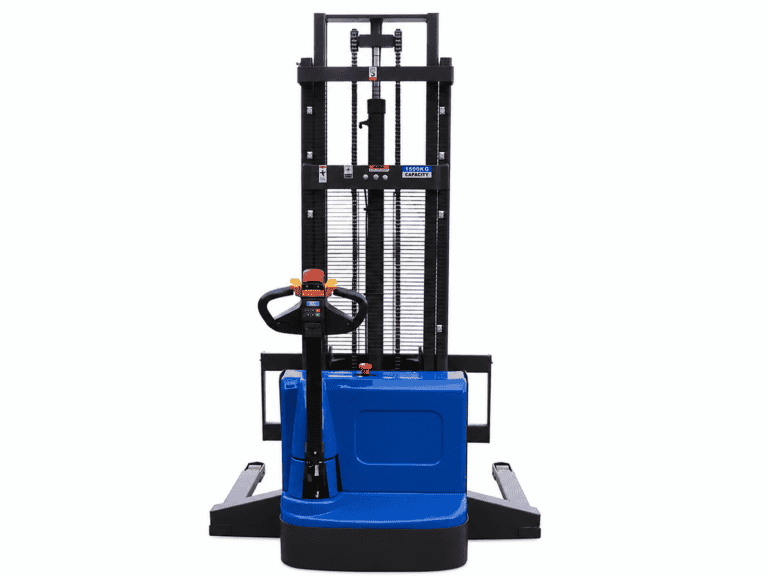
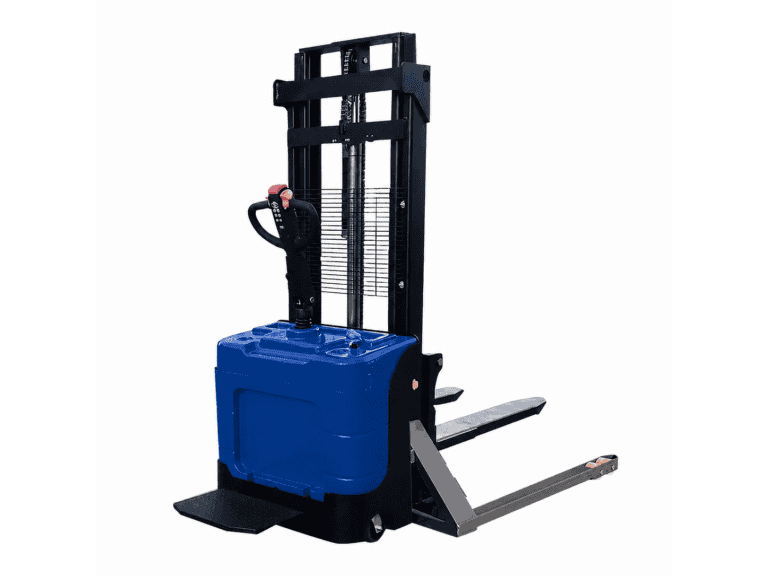
Anxing’s current CDD-1.5T-2T walkie electric pallet stacker illustrates the compact end of this choice. The published range covers 1,500 and 2,000 kg configurations, a 3,500 mm lift, 790–850 mm overall width and a 1,688 mm turning radius. Its overall length is listed at 1,850–1,970 mm depending on configuration. Those dimensions are useful for shortlisting, although they do not replace a working-aisle calculation or pallet-fit review.
For more frequent travel or higher stacking requirements, the current CDD-15-30 stand-on stacker series extends the available range to 1,500–3,000 kg and 3,500–6,000 mm lift configurations. Its platform, mast and capacity variant affect the final length and operating space, so it should be compared as an exact configuration rather than as a generic “ride-on stacker.” The broader electric pallet stacker buying guide covers capacity at height, pallet construction, route and charging in more detail.
When the Forklift Earns Its Extra Size
The forklift becomes the stronger candidate when horizontal movement is as important as stacking. A receiving truck may unload pallets at one end of the building, travel through staging, deliver to several production lines, return finished goods, and then load dispatch vehicles. Even when every pallet weighs less than two tonnes, that route can expose the limits of a compact pedestrian machine.
Mixed loads also shift the decision. A warehouse that handles standard pallets in the morning, steel stillages after lunch and occasional long crates needs more than nominal fork capacity. Fork length, fork positioning, side shift or another approved attachment may be part of normal work. A counterbalanced forklift offers a more practical base for this variety, provided the final capacity is confirmed with the selected mast and attachment.
Ramps, dock plates, floor joints and brief outdoor transfers deserve similar attention. “Electric” does not mean “indoor only,” but neither does it make every electric forklift suitable for rain, loose ground or steep gradients. The surface, tire, electrical protection and permitted grade must match the route. The point is that the forklift category offers a wider range of configurations for these transitions; it is not a blanket approval.
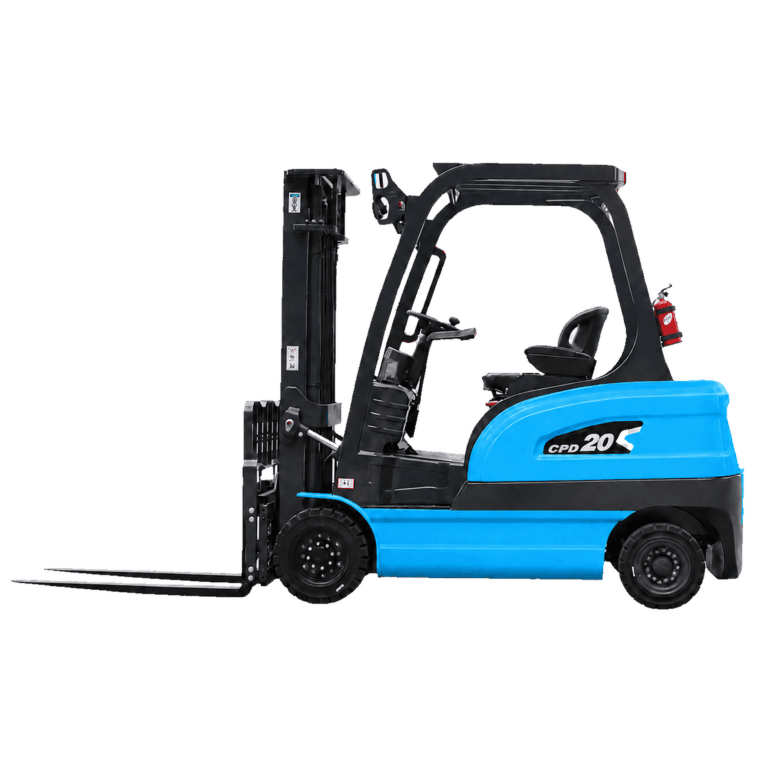
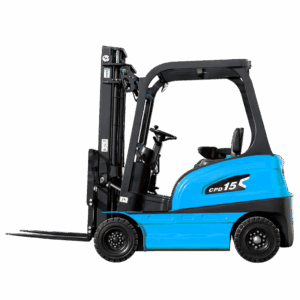
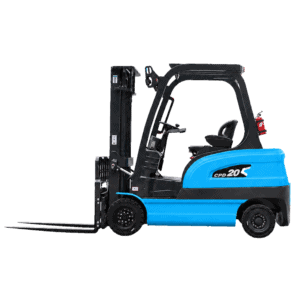
Consider Anxing’s current CPD20 2-ton electric forklift. The published specification lists a 2,000 kg rating at a 500 mm load center, a 3,000 mm standard mast with options up to 6,000 mm, an overall width of 1,100 mm, a 3,410 mm overall length and a 2,230 mm turning radius. It is clearly larger than the CDD walkie stacker, but the same page also lists 10 km/h laden travel speed, several fork lengths and solid or pneumatic tire options. Those differences begin to matter when the route extends beyond one rack aisle.
Why 2 Tonnes and 3.5 Metres Do Not Decide the Category
It is tempting to compare two machines at the same capacity and choose the smaller one. That works only when the smaller machine can complete the whole cycle. The CDD walkie stacker and CPD20 forklift both enter a two-tonne conversation, and both can cover a lift around 3.5 metres through an appropriate configuration. Yet they solve different warehouse problems.
Suppose pallets travel 20 metres from a staging area to a compact rack, with ten or fifteen movements spread across the shift. The pallet base is compatible, the floor is level and no dock work is involved. A stacker may remove unnecessary chassis size and cost.
Now keep the same pallet weight and rack height but move receiving 150 metres away. Add repeated trips, a ramp to the dispatch zone, two pallet styles and a side-shift requirement. The headline load and height have not changed. The operating category probably has.
Residual capacity can alter either choice. Rated capacity is stated under defined conditions; a taller mast, a longer load center, different forks or an attachment can reduce what the truck may carry at the required height. Ask for capacity information for the final configuration rather than treating the model name as a promise at every lift height.
One Warehouse May Need Both
Some buyers try to make one machine cover every task because a single purchase appears simpler. That can leave the daily operation designed around the hardest five percent of work. A large forklift is then driven into compact rack aisles all day because it is needed for occasional dock loading; alternatively, a stacker is pushed into long travel and mixed-load work because it fits the storage area.
Dividing the flow can be more practical. An electric forklift can handle receiving, dispatch and longer cross-warehouse movement. A stacker can remain inside the compact storage or production zone where its dimensions bring a real benefit. The transfer point must be planned, but each machine works closer to its intended duty.
This is especially relevant when the rack layout already exists. If the forklift’s required working aisle cannot be provided without losing storage positions, do not rely on careful steering as the solution. Compare the narrower truck for the rack zone and keep the counterbalanced machine where its flexibility is actually used. The Anxing warehouse and material handling solution looks at equipment by work zone rather than forcing one category across the entire site.
Run the Decision Through a Real Pallet Cycle
Start at the point where the load is collected. Record the pallet or carrier underside, complete loaded dimensions, heaviest credible weight and entry direction. If several carriers are used, the unusual one can set the equipment geometry even when it appears only occasionally.
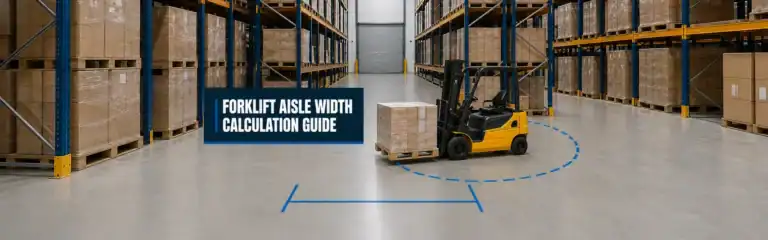
Then walk the route. Measure the narrowest clear aisle, cross aisle, doorway and turning point. Include guards, columns, stored-load overhang, dock plates, slopes and floor damage. Overall machine width answers only whether the body can pass straight through; right-angle stacking needs model-specific working-aisle data for the actual pallet.
Watch one representative cycle and record travel distance, stops, turns and lifts. Multiply that by the expected hourly or shift volume. This exposes whether a walkie stacker is genuinely suitable, whether a stand-on stacker is the better middle ground, or whether the travel and handling variety justify a forklift.
Finally, put the result into the quotation request. State the required lift height and highest loaded condition, battery charging window and local electrical supply, fork or attachment needs, quantity and destination. Ask for the final dimensions, capacity conditions, working-aisle data and supplied configuration in writing. Local operator-training and workplace rules must be checked for either powered truck; a walk-behind control position should never be treated as an automatic exemption.
The Shortlist We Would Make from Your Warehouse Data
If the job is controlled pallet stacking on a firm indoor floor, the first Anxing shortlist is the electric pallet stacker range. We would then separate walkie from stand-on operation using travel distance, handling frequency and available space, before reviewing pallet and rack geometry.
If the work extends across receiving, production and dispatch, or includes mixed carriers, ramps, attachments or sustained travel, start with the Anxing electric forklift range. Capacity class comes after the heaviest complete load, load center and lift height are known.
When the answer remains close, send both equipment categories through the same warehouse drawing and duty-cycle review. The better machine is the one that clears every hard constraint without creating a daily bottleneck—not simply the one with the smaller turning radius, higher tonnage or lower initial quotation.