Key Takeaways
- About 2,200 mm is a useful class-level planning reference for a compact pedestrian stacker handling a European pallet without overhang. The exact requirement is the model-specific Ast for the actual pallet and configuration, plus any site-specific operating allowance.
A compact walkie pallet stacker often needs about 2,200 mm (7.2 ft) of working aisle when handling a European pallet without load overhang. Treat that figure as an early planning reference, not a universal minimum. The correct walkie stacker aisle width is the model-specific right-angle stacking aisle, usually shown as Ast, for your actual pallet, load orientation, and truck configuration. Your warehouse may also need additional operational clearance for rack guards, pallet overhang, floor conditions, pedestrians, and driver variability.
This distinction matters because a truck can travel down an aisle yet still lack enough room to turn a pallet 90 degrees into a rack opening. Likewise, overall truck width and turning radius are useful specifications, but neither one alone proves that a stacker will complete the intended maneuver. Before approving a layout or purchase order, define the maneuver, obtain the relevant Ast value, measure the actual clear aisle, and verify the combination under controlled site conditions.
First Define Which “Aisle Width” You Need
Warehouse teams often use the phrase “aisle width” for several different measurements. That creates avoidable errors in equipment selection. A walkie stacker may need to pass through a doorway, drive along a storage aisle, turn into a rack bay, or reverse at the end of a row. Each task has a different geometric constraint.
| Aisle or clearance | What it describes | Main factors | What to verify |
|---|---|---|---|
| Straight-travel clearance | Space for the truck and load to move forward without turning into a rack | Widest point of truck or load, steering deviation, obstacles, and site rules | Actual truck and loaded-pallet width plus an appropriate operating margin |
| Right-angle stacking aisle (Ast) | Minimum straight aisle in which a loaded truck can turn 90 degrees and place or retrieve the defined pallet | Turning geometry, pallet size and direction, load distance, truck configuration, and the standard allowance used in the data sheet | Ast for the exact model, configuration, and pallet orientation |
| Cross-aisle or row-end space | Space to enter, leave, or reverse direction at the end of a rack row | Overall length, tiller position, turning radius, pallet length, walls, and columns | The real maneuver path, not the rack aisle dimension alone |
| Shared operating aisle | Space used by the stacker together with pedestrians or other equipment | Traffic direction, separation, visibility, speed, passing, and local safety requirements | Site risk assessment and traffic-management controls |
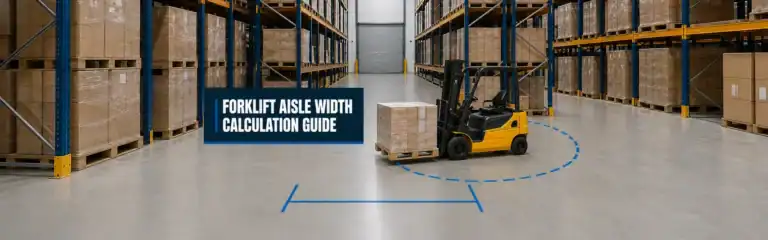
For a rack-facing application, Ast is normally the most relevant starting specification. For a long transfer route, straight-travel width and traffic separation may govern instead. For a dead-end aisle, the cross-aisle or turning pocket can become the limiting dimension even when the rack aisle itself is adequate. A broader explanation of the terminology is available in Anxing’s guide to calculating minimum forklift aisle width.
Why 2,200 mm Is a Starting Point, Not a Promise
Published specifications for pedestrian stackers commonly fall in a range of roughly 2.1 to 2.5 m for defined pallet conditions. The spread is real: different trucks have different chassis lengths, load distances, wheel arrangements, tiller geometries, and turning radii. The same machine can also show different Ast values for two pallet sizes or two pallet orientations.
That is why a statement such as “a walkie stacker needs 2.2 m” is incomplete. It should be read as a class-level planning reference for a compact pedestrian model in a common European-pallet application. If your clear rack aisle is exactly 2,200 mm, do not assume the fit is confirmed. A data-sheet Ast can be higher, and site features can reduce the usable width below the nominal rack-to-rack dimension.
The safest planning rule is:
Required site aisle = model-specific Ast for the actual pallet and configuration + any additional site-specific operational allowance.
This is a planning relationship, not a substitute for a local code or safety assessment. Ask the supplier what allowance is already included in the published Ast method before adding another buffer. Otherwise, you may accidentally count the same clearance twice.
Ast, Turning Radius, and Truck Width Are Not Interchangeable
Three specifications appear frequently on stacker data sheets: overall width, turning radius, and Ast. Each answers a different question.
| Specification | Useful for | What it does not prove |
|---|---|---|
| Overall width | Doorways, straight passages, loading areas, and the truck’s physical envelope | That the loaded truck can turn 90 degrees in front of a rack |
| Turning radius (Wa) | Comparing maneuverability and assessing turns or end-of-row space | The complete stacking aisle, because it does not by itself include the pallet and load geometry |
| Right-angle stacking aisle (Ast) | Planning a 90-degree pallet placement or retrieval under the stated test conditions | Every site condition, traffic rule, obstacle, pallet variation, or operator margin |
Do not calculate the stacking aisle by taking truck width and adding an arbitrary amount. Do not treat Wa as the required aisle. And if a supplier gives you Ast for a specified pallet, do not automatically add the full pallet length again. Ast is intended to describe the whole right-angle maneuver under defined conditions. The useful question is whether those conditions match your warehouse.
Six Factors That Change Walkie Stacker Aisle Width
1. Pallet size and orientation
A pallet’s dimension along the fork direction strongly affects the swept path. An 800 × 1,200 mm pallet approached from the 800 mm entry side presents 1,200 mm along the forks. Rotating the same pallet changes how the truck-load combination moves through the turn. Data sheets may therefore publish separate Ast values for “lengthways” and “crossways” pallet handling. Confirm the meaning of those labels rather than relying on the pallet’s name alone.
2. Load overhang and load shape
Ast calculations normally assume a defined load carrier. Real loads may overhang a pallet, lean, bulge, or use wrapping and corner protectors. A 50 mm overhang on each side increases the swept envelope and can reduce clearance to rack uprights during the turn. Record the maximum loaded dimensions, not just the empty pallet dimensions. For irregular goods, include the worst repeatable production load and any attachment that changes its shape.
3. Fork, support-leg, and pallet compatibility
A stacker’s forks and support legs must enter and surround the pallet correctly. Closed-bottom pallets, low deck clearances, unusual stringer layouts, or blocked fork-entry directions can force a different approach. A nominally narrow aisle is irrelevant if the stacker cannot engage the pallet from the required face. Check fork length, fork spacing, support-leg geometry, pallet opening height, underside structure, and whether bottom boards interfere with travel or lifting.
4. Exact truck configuration
Two products in the same capacity family can have different overall lengths and load distances. Battery compartment, mast choice, initial lift, straddle or fork-over design, wheelbase, and platform configuration can alter the maneuvering envelope. A fold-down platform or protective arms may also change the published value depending on whether they are raised or lowered. Ask for the specification sheet tied to the quotation, not a generic family brochure.
5. The warehouse’s true clear width
Measure between the closest fixed or routinely occupied points. The limiting faces may be rack protectors rather than rack uprights. Pallets stored in the lowest beam can project into the aisle. Columns, walls, sprinkler protection, charging equipment, door hardware, damaged rack components, and floor markings may further reduce the usable path. Measure at several bays and at floor level, then use the narrowest repeatable dimension.
6. Operating environment and traffic
A technical Ast value does not replace safe operating space. Uneven floors, slopes, low visibility, frequent picking activity, fragile loads, cold-store clothing, pedestrian exposure, or two-way traffic can justify a larger margin or different traffic controls. Where pedestrians and powered equipment share space, aisle design should follow the site’s risk assessment and applicable local requirements. A machine that can physically complete the turn may still be unsuitable for the way the aisle is used.
A Practical Seven-Step Aisle-Width Check
- Define the required maneuver. State whether the truck only travels straight, stacks at 90 degrees, turns at the row end, enters a lift, or performs several of these actions.
- Record the real pallet and load. Measure pallet length, width, entry direction, underside clearance, maximum load overhang, load height, and any irregular projection.
- Freeze the proposed truck configuration. Confirm rated capacity, lift height, mast, battery, fork length and spacing, support-leg arrangement, platform status, and any options that affect dimensions.
- Request the matching Ast value. The supplier should identify the pallet dimensions and orientation used, the relevant truck variant, and the clearance convention behind the figure.
- Survey the warehouse. Measure the narrowest clear rack aisle, restricted doorways, row ends, staging areas, and route turns. Include guards, overhanging pallets, walls, columns, and routine obstructions.
- Apply site controls and margin. Account for floor quality, pedestrian separation, operating speed, visibility, load stability, and local rules. Do not assume a universal allowance suits every facility.
- Verify before release. Use a layout simulation, supplier check, or controlled on-site trial with the representative pallet and load. Mark fixed hazards and observe whether the operator can complete the maneuver without encroaching on racks or protected areas.
This workflow converts a general product-class figure into a defensible buying decision. It also gives suppliers enough information to identify a mismatch before production or shipment.
Applying the Method to Anxing’s CDD-1.5T-2T Walkie Stacker
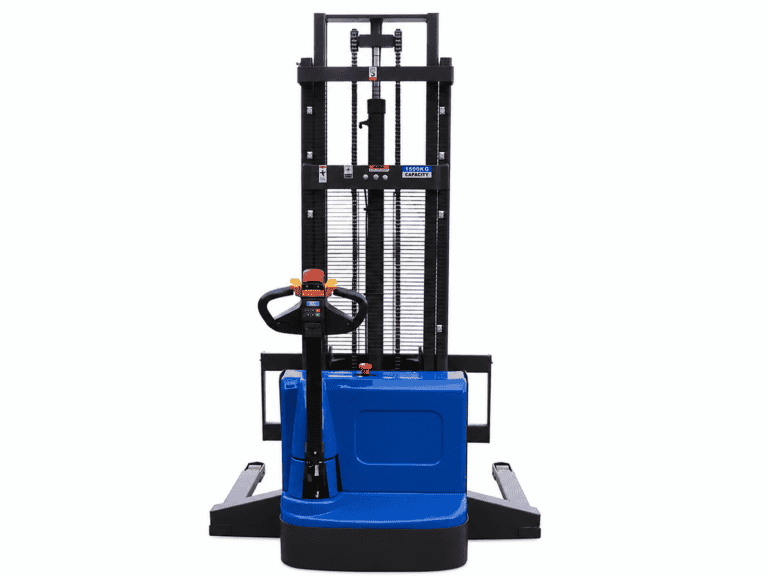
Anxing’s 1.5–2 ton walkie electric pallet stacker is a pedestrian-operated model with configurable rated capacity of 1,500–2,000 kg and a listed lift height of 3,500 mm. Current published dimensions include an overall width of 790–850 mm, an overall length of 1,850–1,970 mm, and a turning radius of 1,688 mm, depending on configuration. Fork dimensions are listed as 50 × 160 × 1,150–1,200 mm and are customizable.
Those figures are useful inputs, but they do not establish the minimum right-angle stacking aisle. For this model, a buyer should provide the pallet and loaded-product dimensions, entry direction, lift height, required capacity, rack opening, aisle survey, and any obstructions. Anxing can then confirm the intended configuration and the applicable maneuvering requirement. Using 790–850 mm overall width or 1,688 mm turning radius as the aisle requirement would materially understate the space needed for a loaded 90-degree stack.
If capacity, lift height, operator format, or route length is still open, compare the available electric pallet stacker range before fixing the rack layout. The broader electric pallet stacker buying guide also covers load, pallet, mast, duty cycle, floor, and battery questions that should be resolved alongside aisle width.
Three Common Planning Scenarios
Scenario A: European pallet with no overhang
A warehouse plans to handle consistent 800 × 1,200 mm pallets with compact loads entirely inside the pallet footprint. A roughly 2,200 mm aisle can be used for early layout screening for a pedestrian stacker. The final decision still requires the selected model’s Ast for the stated entry direction and configuration, followed by a check of guards, stored-pallet projection, and site margin.
Scenario B: Same pallet, wider finished load
The pallet remains 800 × 1,200 mm, but cartons overhang to 900 mm wide. The pallet label has not changed, yet the load’s swept envelope is larger. The buyer should submit 900 mm as the loaded width, including stretch wrap or corner protection, and verify clearance through the full turn. A value based only on the empty pallet can give false confidence near rack uprights.
Scenario C: A nonstandard or closed-bottom pallet
The aisle appears wide enough, but bottom boards prevent the proposed fork-over stacker from engaging the pallet in the required direction. The real solution may involve a different pallet entry, fork spacing, support-leg arrangement, or stacker design. That change can alter both the approach and the required aisle. Pallet compatibility and aisle width must therefore be checked together.
Common Aisle-Planning Mistakes
- Using overall width as stacking aisle width. A narrow chassis can pass straight through a space that is far too tight for a loaded right-angle turn.
- Using turning radius as Ast. Wa describes part of the maneuvering geometry; it does not capture the whole truck-pallet envelope.
- Measuring nominal rack spacing only. Rack guards, pallet projection, columns, walls, and installed equipment can define the actual clear width.
- Ignoring pallet direction. Changing the fork-entry side changes the load length along the forks and may change Ast.
- Testing an empty machine. A truck that turns comfortably without a load may sweep a much larger path with a pallet on the forks.
- Adding or omitting clearance blindly. First determine what the supplier’s Ast already includes, then apply the site-specific margin required by the operating risk.
- Accepting a generic family specification. Capacity, mast, battery, fork, leg, and platform choices can make the quoted unit different from the brochure example.
When a Walkie Stacker May Not Be the Best Fit
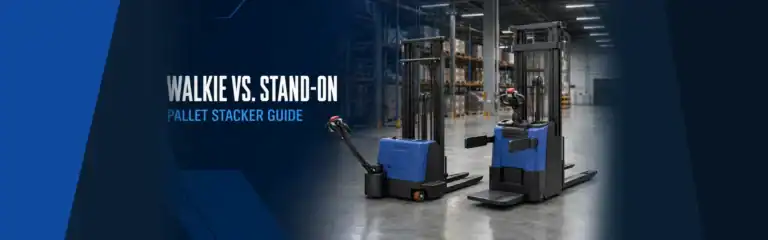
A walkie stacker is often well suited to short, controlled movements, moderate throughput, and compact indoor areas. It may be less suitable when operators travel long distances repeatedly, when the required duty cycle is high, or when the layout demands a configuration with a different maneuvering envelope. A stand-on unit can improve travel productivity but commonly needs more maneuvering room because of its longer operator platform or compartment. Anxing’s walkie versus stand-on stacker comparison explains the operating trade-offs.
If the aisle is extremely constrained, do not force the decision around a preferred truck label. Review pallet direction, rack depth, beam layout, support-leg compatibility, turning pockets, and alternative stacker configurations as one system. A small rack adjustment can sometimes prevent a permanent operating bottleneck; in other cases, a different equipment class is the safer answer.
Information to Send With Your Aisle-Width Enquiry
A useful request for quotation should include:
- pallet length, width, height, underside layout, and fork-entry direction;
- maximum loaded dimensions, weight, center of gravity, and overhang;
- required lift height and residual-capacity requirement at that height;
- rack opening, lowest-beam arrangement, and pallet projection into the aisle;
- narrowest measured clear aisle and the objects that define it;
- doorways, columns, row ends, slopes, floor joints, and other route constraints;
- travel distance, shifts per day, pallets per hour, and pedestrian interaction;
- photos or a dimensioned plan showing travel direction and stacking approach;
- any required fork, mast, battery, leg, or platform configuration.
Ask the supplier to identify the Ast value for that exact combination and to state the pallet dimensions, orientation, and configuration behind the result. If Ast is unavailable, request a geometry review or a controlled fit test; do not approve the aisle from Wa or overall width alone.
Final Recommendation
Use approximately 2,200 mm as an initial planning reference for a compact walkie stacker with a common European pallet and no overhang. Then replace that estimate with the selected model’s Ast for the real pallet, load, and configuration. Measure the narrowest usable aisle between actual limiting faces, address traffic and site risks, and verify the maneuver before ordering equipment or finalizing racks.
The key purchasing question is not “What aisle does a walkie stacker usually need?” It is “Can this exact stacker, carrying this exact load in this orientation, complete our exact maneuver with safe operational clearance?” Supplying those inputs early lets Anxing recommend a configuration that fits the warehouse on paper and in daily operation.