
Key Takeaways
- Choose a 3-wheel electric forklift when tight turns, short cross aisles and frequent pallet positioning are the main constraints. Choose a 4-wheel model when heavier loads, longer travel, ramps, surface transitions or mixed operating zones require a broader working envelope. Compare both at the same capacity, lift height, load center, attachment and battery duty before deciding.
The most useful comparison is made at the same rated capacity, load center, lift height, mast, forks, attachment and battery duty. A compact 1.5-ton 3-wheel truck should not be judged against a much larger 3.5-ton 4-wheel truck as though the wheel layout created every difference. Start with the application requirements in our forklift selection guide, then use the wheel configuration to resolve the tradeoff between maneuverability and operating envelope.
What Actually Changes Between 3-Wheel and 4-Wheel Forklifts?
Both machines in this comparison are battery-electric, counterbalanced, sit-down forklifts. They can use similar mast, fork, tire, battery and attachment concepts. The important structural difference is at the steering end of the truck.
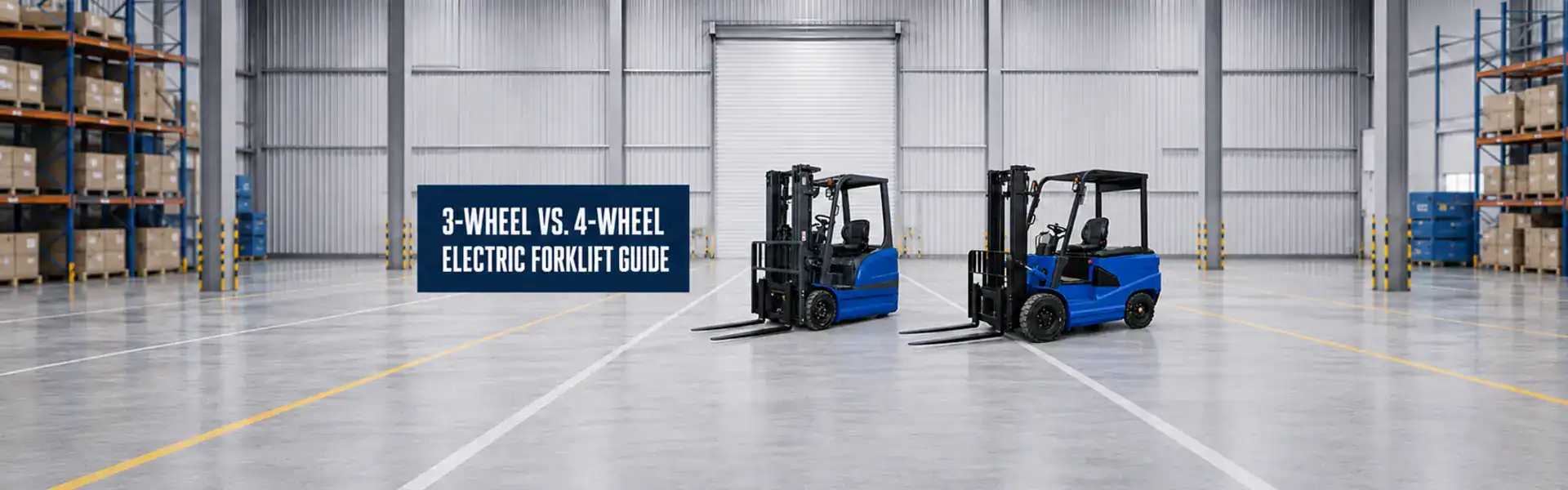
A typical 3-wheel electric forklift has two front drive-wheel positions and a compact rear steering arrangement. Depending on the design, the rear assembly may use a single wheel or closely paired wheels that act at one central steering position. This layout can let the rear of the truck rotate through a tighter path, reducing the space needed to align with a pallet.
A typical 4-wheel electric forklift has two front and two rear wheel positions. Its longer or wider-supported chassis is often used across a broader capacity range and can feel more settled during straight travel, surface transitions and demanding load cycles. However, it generally needs a larger turning envelope than a comparable 3-wheel model.
Wheel count alone does not define capacity, speed, gradeability, battery runtime or safe lift height. Those values belong to the exact model and configuration. The 4-wheel truck may offer a higher-capacity range because of its complete chassis design, not because one additional visible wheel creates a universal capacity increase.
3-Wheel vs. 4-Wheel Electric Forklift Comparison
| Decision factor | 3-wheel electric forklift | 4-wheel electric forklift | What the buyer should verify |
|---|---|---|---|
| Primary advantage | Compact turning and easier repositioning in restricted layouts | Broader operating and capacity envelope | Which constraint actually limits production: space, load, surface or travel |
| Turning | Usually the tighter turning option within a comparable capacity class | Usually requires more room to rotate and square up | Model-specific turning radius and Ast with the actual pallet |
| Capacity range | Commonly concentrated in light and medium warehouse work | Commonly available across light, medium and higher capacities | Permitted capacity at the required height and load center |
| Floor conditions | Best matched to firm, level and well-maintained floors | Often the more suitable starting point for joints, thresholds and mixed paved routes | Tire type, ground clearance, surface damage, gradients and manufacturer approval |
| Long travel | Strong where frequent turns and pallet approaches dominate the cycle | Often favored where straight travel and route variation dominate | Loaded travel speed, braking, energy use and operator comfort on the actual route |
| High or irregular loads | Suitable only within the truck’s confirmed residual-capacity conditions | Often provides more model choices for heavier or demanding load profiles | Load dimensions, offset center of gravity, mast, attachment and capacity plate |
| Outdoor work | Possible only where the selected model suits the firm surface, weather and route | Usually offers more paved indoor-outdoor options, but is not automatically rough-terrain equipment | Electrical protection, tires, moisture, temperature, slope and surface firmness |
| Purchase comparison | May avoid paying for an operating envelope the warehouse does not need | May avoid underspecifying a truck that must serve several work zones | Like-for-like quotation, battery system, charger, options, parts and delivered scope |
The table describes class-level tendencies, not guaranteed specifications. Some modern 4-wheel trucks are compact, while some 3-wheel configurations are physically longer than expected. Compare technical sheets using the same definitions and ask the supplier to identify which dimensions change with capacity, battery, mast, forks, tires and attachments.
Choose 3-Wheel When Maneuverability Is the Binding Constraint
A turning-radius advantage matters most when it removes repeated corrections from the work cycle. In a rack aisle, a truck must turn with its counterweight, mast, forks and load while clearing stored pallets, rack guards and nearby traffic. A compact rear steering point can reduce the swept path and help the operator align with the pallet face with fewer forward-and-reverse adjustments.
Do not decide from truck width alone. Two forklifts can have similar overall widths and still require different right-angle stacking space. The working aisle depends on turning radius, front overhang, fork-face position, pallet dimensions, pallet orientation and the calculation allowance. Use the model’s published Ast when it is stated for your pallet, or follow the two-method process in our forklift aisle-width calculation guide.
Measure more than the rack-to-rack distance. The tightest point may be a cross aisle, rack end, column, door, charging bay or staging lane. A 3-wheel truck can improve geometric fit, but it does not make an aisle safe if the layout has inadequate operational clearance or unmanaged pedestrian traffic.
Choose 4-Wheel When the Operating Envelope Is the Binding Constraint
A 4-wheel electric forklift is normally the first class to investigate when the job exceeds the available 3-wheel capacity range, includes long loaded travel or regularly crosses dock plates, expansion joints and paved indoor-outdoor transitions. The correct reason is the complete truck design and available configuration range, not the simplistic claim that four visible wheels create four independent stability points.
Most counterbalanced forklifts use a three-point suspension concept: the two front contact points and the central pivot of the rear steer axle form a stability triangle. The combined center of gravity of truck and load must remain within the applicable stability region. Load height, turning, braking, slope, off-center weight and sudden movement can shift that combined center of gravity on either wheel layout.
Rated capacity is also conditional. A truck rated for a stated load at a stated load center does not necessarily retain that capacity with a taller mast, a long load or a heavy attachment. Review the relationship between load center and actual forklift capacity, then request the residual-capacity information for the quoted mast and attachment.
Four-wheel electric does not mean rough terrain. Firm yard pavement and controlled loading areas are different from loose gravel, deep potholes, mud or construction ground. If the route is genuinely uneven or soft, changing from three wheels to four wheels within the warehouse-forklift class may not solve the application.
Compare the Whole Work Cycle, Not One Turn
A forklift that turns tightly can still be the slower choice if most of the shift is spent traveling between receiving and production. Conversely, a truck that feels settled on a long run can lose time if every pallet placement requires several steering corrections. Map one complete cycle and count the operations rather than relying on a general description such as “warehouse use.”
Turning-intensive cycle
Frequent rack entries, short travel legs, restricted cross aisles and dense storage favor the maneuverability of a 3-wheel layout. The buyer should still confirm capacity at height, steering response, floor condition and operator visibility with the selected mast.
Travel-intensive cycle
Long straight runs, repeated dock movement, thresholds and varied paved routes often justify comparing 4-wheel models first. Loaded travel performance, braking behavior, battery energy use and driver comfort should be evaluated together.
Mixed-zone cycle
Some facilities should not force one truck to serve every zone. A compact 3-wheel forklift can handle tight storage aisles while a 4-wheel truck covers receiving, production supply and longer transfers. The warehouse material-handling solution explains how to divide equipment by load flow, stacking task and route.
Do Battery, Tires and Attachments Change the Choice?
Battery chemistry does not belong exclusively to either wheel layout. Runtime depends on battery capacity, truck energy demand, load weight, travel distance, lift frequency, temperature and charging windows. Compare both quotations against the same operating hours and peak cycle, and confirm charger input voltage, frequency, phase, connector and charging strategy for the destination site.
Tires can materially change ride, clearance and floor interaction. A compact truck on tires intended for smooth floors should not be selected for broken pavement merely because its rated capacity is sufficient. Ask which tire options are approved for the chosen configuration and how they affect dimensions, turning data, capacity or ground clearance.
Attachments can shift the decision in two ways. First, their mass and effective thickness may reduce residual capacity. Second, a side-shift, clamp, rotator or longer fork can change the load position and swept envelope. Request capacity and aisle information with the attachment installed rather than adding it after selecting the base truck.
How the Current Anxing Ranges Compare
The current Anxing catalog provides two relevant starting points, but the published ranges should not be treated as a controlled test between identical trucks.
The 1.2–2 ton 3-wheel electric forklift range lists rated capacities from 1,200 to 2,000 kg, a 3,000 mm standard lift height, 1,100–1,200 mm overall width and turning radius from 1,590 mm depending on configuration. Its published purpose is compact pallet handling in warehouses, factories and loading areas. The final length, steering performance, battery, mast, tires and attachments vary with the selected configuration.
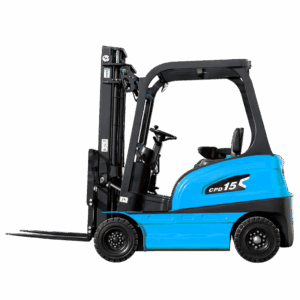
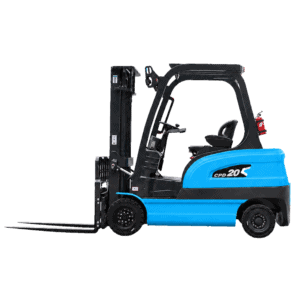
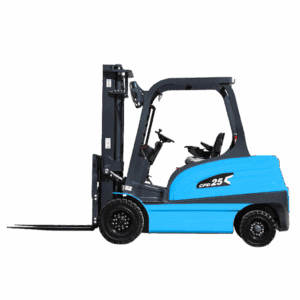
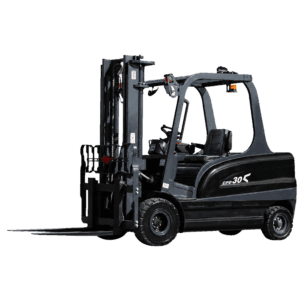
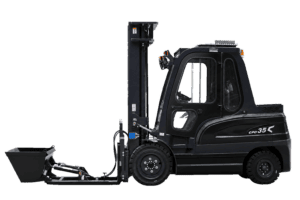
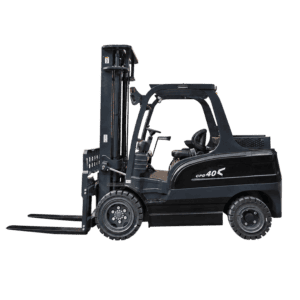
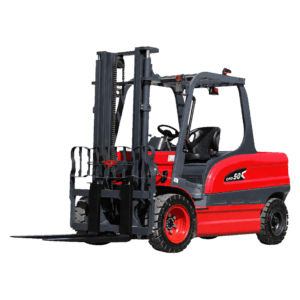
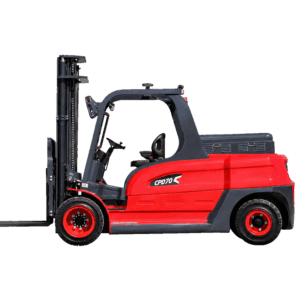
The 1.5–3.5 ton electric forklift range provides the conventional four-wheel comparison class across 1,500–3,500 kg configurations. Its page lists a 3,000 mm standard lift height, 1,200 mm overall width and overall length from 2,300 to 2,700 mm depending on capacity. Model-specific turning and Ast data should be requested for the selected variant rather than inferred from the overall width.
The ranges overlap at 1.5 and 2 tons, making those capacities the most useful starting point for a like-for-like comparison. Send one application sheet and request both alternatives with the same load center, mast, lift height, fork length, attachment, tire type, battery duty and pallet. For loads above 2,000 kg, the current 3-wheel range no longer covers the stated requirement, so the buyer should investigate the broader electric forklift range.
Three Practical Selection Examples
Dense indoor pallet storage
A warehouse regularly moves 1,200 kg pallets over short distances and turns into compact rack aisles on a smooth, level floor. The maximum load and height fall within both shortlisted trucks. Here, the 3-wheel model is the logical first candidate, but only after its Ast is confirmed for the actual pallet and a controlled site-fit review checks rack ends and cross aisles.
Production supply with dock transitions
A factory moves loads from receiving to production over longer routes, crosses joints and dock plates, and sometimes works on firm outdoor pavement. Even if the maximum load is below 2 tons, the route and duty may justify a 4-wheel comparison. Tire selection, gradient, weather exposure and loaded travel performance become more important than the smallest possible turn.
Variable loads up to 2.8 tons
An operation handles 1.5-ton pallets most days but regularly receives loads approaching 2.8 tons. Choosing a 2-ton 3-wheel truck for the average load would leave the peak requirement uncovered. A suitably configured 4-wheel model should be reviewed against the heaviest actual load, its dimensions and the required stacking height.
A 9-Step Selection Workflow
- Define every regular and peak load. Record maximum weight, dimensions, load center, fork-entry direction and any offset center of gravity.
- Confirm the lift task. Provide the highest pallet position, required free lift, overhead clearance and mast-height limit.
- Measure the complete route. Include the narrowest aisle, cross aisle, door, rack end, elevator, container and turning point.
- Record surface conditions. Identify joints, damage, thresholds, dock plates, ramps, gradients and indoor-outdoor transitions.
- Map the duty cycle. Estimate shifts, hours, travel distance, pallets per hour, lifts, idle periods and charging windows.
- Specify attachments and forks. Include side shift, clamps, rotators, fork length and any unusual load support.
- Shortlist by hard limits. Remove any truck that cannot meet capacity, residual capacity, height, access, surface or charging requirements.
- Compare the remaining trucks like for like. Request Ast, turning data, capacity, battery, charger, tires and options for the same application.
- Validate the final configuration. Review the approved specification and capacity information, then complete the buyer’s controlled site and safety checks before normal operation.
What to Include in a 3-Wheel vs. 4-Wheel Forklift RFQ
- maximum and typical load weight, complete dimensions and center of gravity;
- required lift height, top pallet height, free-lift requirement and overhead limits;
- pallet size, entry direction, fork length and required attachments;
- narrowest clear aisle, cross-aisle width, door sizes and a dimensioned layout;
- floor condition, ramps, dock plates, gradients and outdoor sections;
- daily hours, shifts, travel distance, throughput and charging windows;
- local power supply, preferred battery type and charger requirements;
- quantity, destination country, city or port, and required product documents.
A useful quotation should identify the exact capacity variant, mast, forks, attachment, tires, battery, charger and key dimensions. If both wheel layouts remain viable, request both configurations against the same application sheet. That creates a defensible comparison of aisle fit, operating coverage and delivered scope instead of a decision based on wheel count alone.