
Puntos clave
- Elige una carretilla elevadora eléctrica de tres ruedas cuando las curvas cerradas, los pasillos transversales cortos y el posicionamiento frecuente de paletas sean las principales limitaciones. Elige un modelo de cuatro ruedas cuando las cargas más pesadas, los recorridos más largos, las rampas, los cambios de superficie o las zonas operativas mixtas requieran un área de trabajo más amplia. Compara ambos modelos con la misma capacidad, altura de elevación, centro de gravedad, accesorios y ciclo de uso de la batería antes de decidirte.
La comparación más útil se realiza cuando se tienen en cuenta la misma capacidad nominal, el centro de carga, la altura de elevación, el mástil, las horquillas, el accesorio y el ciclo de trabajo de la batería. Una carretilla compacta de 1.5 toneladas y 3 ruedas no debe compararse con una carretilla mucho más grande de 3.5 toneladas y 4 ruedas, como si la disposición de las ruedas fuera la única diferencia. Comience por los requisitos de la aplicación en nuestro Guía para elegir una carretilla elevadora, y luego utiliza la configuración de las ruedas para encontrar el equilibrio entre la maniobrabilidad y el ámbito operativo.
¿En qué se diferencian realmente las montacargas de tres ruedas de las de cuatro ruedas?
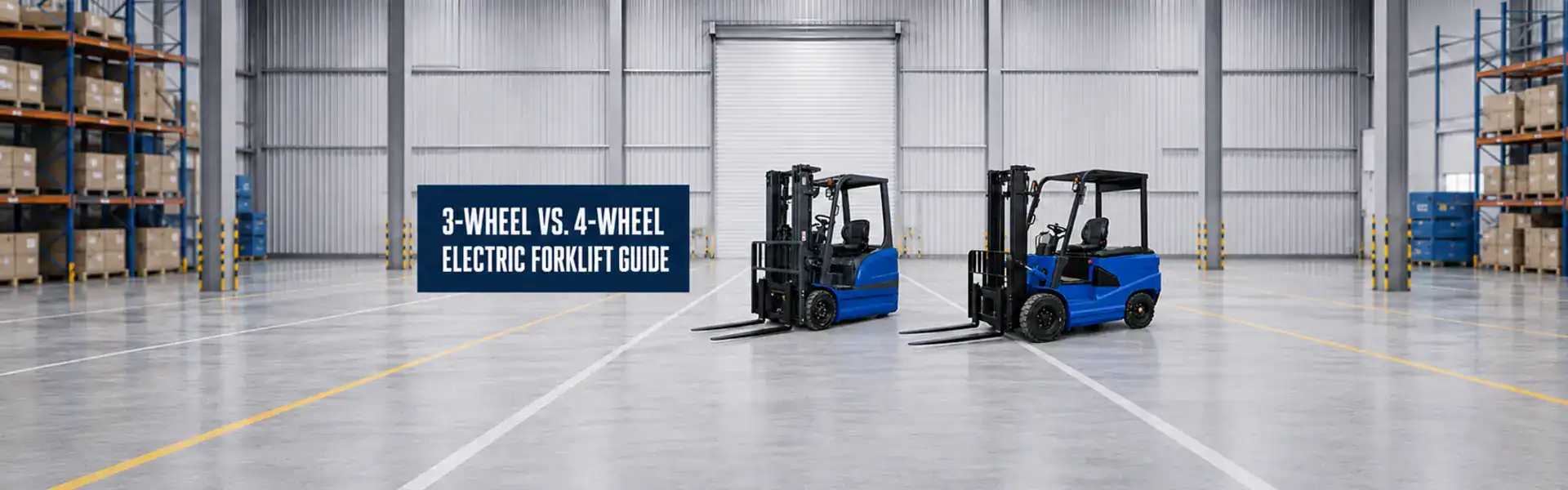
Ambas máquinas de esta comparación son montacargas eléctricos a batería, de contrapeso y con asiento. Pueden utilizar conceptos similares en cuanto a mástil, horquillas, llantas, batería y accesorios. La diferencia estructural importante se encuentra en el extremo de la dirección del montacargas.
Una carretilla elevadora eléctrica típica de tres ruedas cuenta con dos ruedas motrices delanteras y un sistema de dirección trasero compacto. Dependiendo del diseño, el conjunto trasero puede utilizar una sola rueda o un par de ruedas muy juntas que actúan en un único punto central de dirección. Esta configuración permite que la parte trasera de la carretilla gire en un radio más cerrado, lo que reduce el espacio necesario para alinearse con un palé.
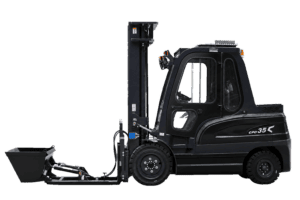
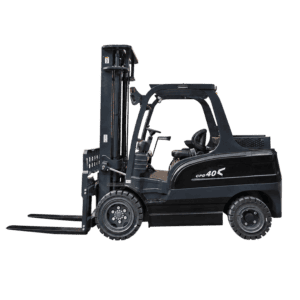
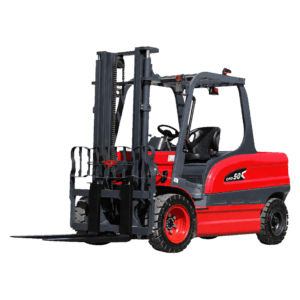
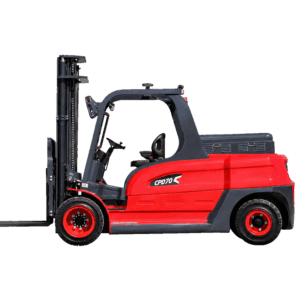
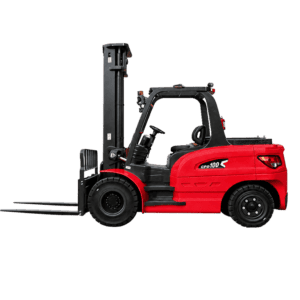
Una montacargas eléctrica típica de cuatro ruedas cuenta con dos posiciones de ruedas delanteras y dos traseras. Su chasis, más largo o con mayor anchura, suele utilizarse en un rango de capacidad más amplio y puede ofrecer una mayor estabilidad durante la marcha en línea recta, los cambios de superficie y los ciclos de carga exigentes. Sin embargo, por lo general requiere un radio de giro mayor que un modelo comparable de tres ruedas.
El número de ruedas por sí solo no determina la capacidad, la velocidad, la capacidad de subida de pendientes, la autonomía de la batería ni la altura de elevación segura. Esos valores dependen del modelo y la configuración específicos. La carretilla de cuatro ruedas puede ofrecer una mayor capacidad gracias al diseño integral de su chasis, no porque una rueda adicional visible genere un aumento universal de la capacidad.
Comparación entre montacargas eléctricos de 3 ruedas y de 4 ruedas
| Factor decisivo | Montacargas eléctrico de tres ruedas | Montacargas eléctrico de cuatro ruedas | Lo que el comprador debe verificar |
|---|---|---|---|
| Ventaja principal | Giros compactos y un reposicionamiento más sencillo en espacios reducidos | Rango operativo y de capacidad más amplio | ¿Qué factor limita realmente la producción: el espacio, la carga, la superficie o el recorrido? |
| Girando | Por lo general, la opción con radio de giro más cerrado dentro de una clase de capacidad comparable | Por lo general, requiere más espacio para girar y alinearse | Radio de giro específico del modelo y Ast con la paleta real |
| Rango de capacidad | Por lo general, se centra en tareas de almacén ligeras y de intensidad media | Generalmente disponibles en capacidades ligeras, medianas y altas | Capacidad permitida a la altura requerida y en el centro de carga |
| Condiciones del piso | Ideal para pisos firmes, nivelados y en buen estado | A menudo, el punto de partida más adecuado para juntas, umbrales y rutas con pavimentos mixtos | Tipo de llanta, distancia al suelo, daños en la superficie, pendientes y aprobación del fabricante |
| Viaje largo | Ideal cuando el ciclo se caracteriza por giros frecuentes y aproximaciones de paletas | A menudo se prefiere cuando predominan los recorridos rectos y las variaciones de ruta | Velocidad de desplazamiento con carga, frenado, consumo de energía y comodidad del operador en la ruta real |
| Cargas elevadas o irregulares | Apto únicamente dentro de las condiciones de capacidad residual confirmadas del camión | A menudo ofrece más opciones de modelos para perfiles de carga más pesados o exigentes | Dimensiones de la carga, desplazamiento del centro de gravedad, mástil, placa de fijación y placa de capacidad |
| Trabajo al aire libre | Solo es posible cuando el modelo seleccionado se adapta a la superficie firme, las condiciones climáticas y la ruta | Por lo general, ofrece más opciones para uso en interiores y exteriores sobre superficies pavimentadas, pero no se trata necesariamente de equipo para terrenos accidentados | Protección eléctrica, llantas, humedad, temperatura, pendiente y firmeza de la superficie |
| Comparación de compras | Podría evitar el pago de un presupuesto operativo que el almacén no necesita | Podría evitar que se especifiquen de manera insuficiente las características de un camión que debe prestar servicio en varias zonas de trabajo | Cotización comparativa, sistema de baterías, cargador, opciones, piezas y alcance de la entrega |
La tabla describe tendencias a nivel de clase, no especificaciones garantizadas. Algunas carretillas modernas de 4 ruedas son compactas, mientras que algunas configuraciones de 3 ruedas son físicamente más largas de lo esperado. Compara las hojas técnicas utilizando las mismas definiciones y pídele al proveedor que identifique qué dimensiones varían según la capacidad, la batería, el mástil, las horquillas, las llantas y los accesorios.
Elige un vehículo de tres ruedas cuando la maniobrabilidad sea la restricción clave
A turning-radius advantage matters most when it removes repeated corrections from the work cycle. In a rack aisle, a truck must turn with its counterweight, mast, forks and load while clearing stored pallets, rack guards and nearby traffic. A compact rear steering point can reduce the swept path and help the operator align with the pallet face with fewer forward-and-reverse adjustments.
Do not decide from truck width alone. Two forklifts can have similar overall widths and still require different right-angle stacking space. The working aisle depends on turning radius, front overhang, fork-face position, pallet dimensions, pallet orientation and the calculation allowance. Use the model’s published Ast when it is stated for your pallet, or follow the two-method process in our forklift aisle-width calculation guide.
Measure more than the rack-to-rack distance. The tightest point may be a cross aisle, rack end, column, door, charging bay or staging lane. A 3-wheel truck can improve geometric fit, but it does not make an aisle safe if the layout has inadequate operational clearance or unmanaged pedestrian traffic.
Choose 4-Wheel When the Operating Envelope Is the Binding Constraint
A 4-wheel electric forklift is normally the first class to investigate when the job exceeds the available 3-wheel capacity range, includes long loaded travel or regularly crosses dock plates, expansion joints and paved indoor-outdoor transitions. The correct reason is the complete truck design and available configuration range, not the simplistic claim that four visible wheels create four independent stability points.
Most counterbalanced forklifts use a three-point suspension concept: the two front contact points and the central pivot of the rear steer axle form a stability triangle. The combined center of gravity of truck and load must remain within the applicable stability region. Load height, turning, braking, slope, off-center weight and sudden movement can shift that combined center of gravity on either wheel layout.
Rated capacity is also conditional. A truck rated for a stated load at a stated load center does not necessarily retain that capacity with a taller mast, a long load or a heavy attachment. Review the relationship between load center and actual forklift capacity, then request the residual-capacity information for the quoted mast and attachment.
Four-wheel electric does not mean rough terrain. Firm yard pavement and controlled loading areas are different from loose gravel, deep potholes, mud or construction ground. If the route is genuinely uneven or soft, changing from three wheels to four wheels within the warehouse-forklift class may not solve the application.
Compare the Whole Work Cycle, Not One Turn
A forklift that turns tightly can still be the slower choice if most of the shift is spent traveling between receiving and production. Conversely, a truck that feels settled on a long run can lose time if every pallet placement requires several steering corrections. Map one complete cycle and count the operations rather than relying on a general description such as “warehouse use.”
Turning-intensive cycle
Frequent rack entries, short travel legs, restricted cross aisles and dense storage favor the maneuverability of a 3-wheel layout. The buyer should still confirm capacity at height, steering response, floor condition and operator visibility with the selected mast.
Travel-intensive cycle
Long straight runs, repeated dock movement, thresholds and varied paved routes often justify comparing 4-wheel models first. Loaded travel performance, braking behavior, battery energy use and driver comfort should be evaluated together.
Mixed-zone cycle
Some facilities should not force one truck to serve every zone. A compact 3-wheel forklift can handle tight storage aisles while a 4-wheel truck covers receiving, production supply and longer transfers. The warehouse material-handling solution explains how to divide equipment by load flow, stacking task and route.
Do Battery, Tires and Attachments Change the Choice?
Battery chemistry does not belong exclusively to either wheel layout. Runtime depends on battery capacity, truck energy demand, load weight, travel distance, lift frequency, temperature and charging windows. Compare both quotations against the same operating hours and peak cycle, and confirm charger input voltage, frequency, phase, connector and charging strategy for the destination site.
Tires can materially change ride, clearance and floor interaction. A compact truck on tires intended for smooth floors should not be selected for broken pavement merely because its rated capacity is sufficient. Ask which tire options are approved for the chosen configuration and how they affect dimensions, turning data, capacity or ground clearance.
Attachments can shift the decision in two ways. First, their mass and effective thickness may reduce residual capacity. Second, a side-shift, clamp, rotator or longer fork can change the load position and swept envelope. Request capacity and aisle information with the attachment installed rather than adding it after selecting the base truck.
How the Current Anxing Ranges Compare
The current Anxing catalog provides two relevant starting points, but the published ranges should not be treated as a controlled test between identical trucks.
El 1.2–2 ton 3-wheel electric forklift range lists rated capacities from 1,200 to 2,000 kg, a 3,000 mm standard lift height, 1,100–1,200 mm overall width and turning radius from 1,590 mm depending on configuration. Its published purpose is compact pallet handling in warehouses, factories and loading areas. The final length, steering performance, battery, mast, tires and attachments vary with the selected configuration.
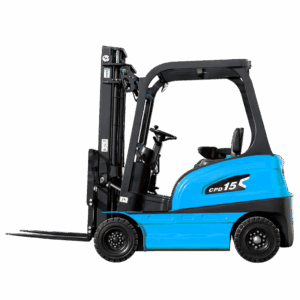
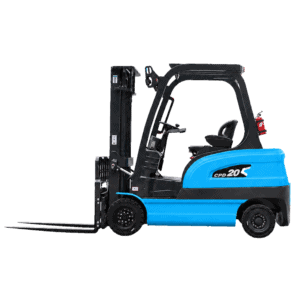
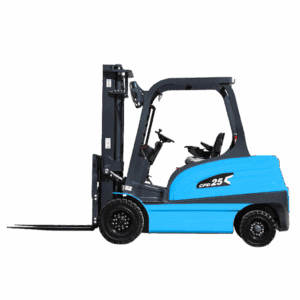
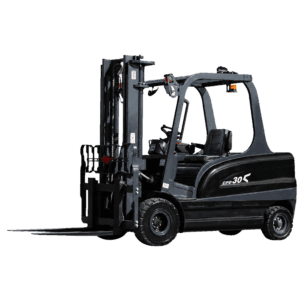
El Gama de montacargas eléctricos de 1,5 a 3,5 toneladas provides the conventional four-wheel comparison class across 1,500–3,500 kg configurations. Its page lists a 3,000 mm standard lift height, 1,200 mm overall width and overall length from 2,300 to 2,700 mm depending on capacity. Model-specific turning and Ast data should be requested for the selected variant rather than inferred from the overall width.
The ranges overlap at 1.5 and 2 tons, making those capacities the most useful starting point for a like-for-like comparison. Send one application sheet and request both alternatives with the same load center, mast, lift height, fork length, attachment, tire type, battery duty and pallet. For loads above 2,000 kg, the current 3-wheel range no longer covers the stated requirement, so the buyer should investigate the broader electric forklift range.
Three Practical Selection Examples
Dense indoor pallet storage
A warehouse regularly moves 1,200 kg pallets over short distances and turns into compact rack aisles on a smooth, level floor. The maximum load and height fall within both shortlisted trucks. Here, the 3-wheel model is the logical first candidate, but only after its Ast is confirmed for the actual pallet and a controlled site-fit review checks rack ends and cross aisles.
Production supply with dock transitions
A factory moves loads from receiving to production over longer routes, crosses joints and dock plates, and sometimes works on firm outdoor pavement. Even if the maximum load is below 2 tons, the route and duty may justify a 4-wheel comparison. Tire selection, gradient, weather exposure and loaded travel performance become more important than the smallest possible turn.
Variable loads up to 2.8 tons
An operation handles 1.5-ton pallets most days but regularly receives loads approaching 2.8 tons. Choosing a 2-ton 3-wheel truck for the average load would leave the peak requirement uncovered. A suitably configured 4-wheel model should be reviewed against the heaviest actual load, its dimensions and the required stacking height.
A 9-Step Selection Workflow
- Define every regular and peak load. Record maximum weight, dimensions, load center, fork-entry direction and any offset center of gravity.
- Confirm the lift task. Provide the highest pallet position, required free lift, overhead clearance and mast-height limit.
- Measure the complete route. Include the narrowest aisle, cross aisle, door, rack end, elevator, container and turning point.
- Record surface conditions. Identify joints, damage, thresholds, dock plates, ramps, gradients and indoor-outdoor transitions.
- Map the duty cycle. Estimate shifts, hours, travel distance, pallets per hour, lifts, idle periods and charging windows.
- Specify attachments and forks. Include side shift, clamps, rotators, fork length and any unusual load support.
- Shortlist by hard limits. Remove any truck that cannot meet capacity, residual capacity, height, access, surface or charging requirements.
- Compare the remaining trucks like for like. Request Ast, turning data, capacity, battery, charger, tires and options for the same application.
- Validate the final configuration. Review the approved specification and capacity information, then complete the buyer’s controlled site and safety checks before normal operation.
What to Include in a 3-Wheel vs. 4-Wheel Forklift RFQ
- maximum and typical load weight, complete dimensions and center of gravity;
- required lift height, top pallet height, free-lift requirement and overhead limits;
- pallet size, entry direction, fork length and required attachments;
- narrowest clear aisle, cross-aisle width, door sizes and a dimensioned layout;
- floor condition, ramps, dock plates, gradients and outdoor sections;
- daily hours, shifts, travel distance, throughput and charging windows;
- local power supply, preferred battery type and charger requirements;
- quantity, destination country, city or port, and required product documents.
A useful quotation should identify the exact capacity variant, mast, forks, attachment, tires, battery, charger and key dimensions. If both wheel layouts remain viable, request both configurations against the same application sheet. That creates a defensible comparison of aisle fit, operating coverage and delivered scope instead of a decision based on wheel count alone.