Key Takeaways
- A forklift’s rated capacity applies only at the load center and configuration stated on its capacity plate. When the actual center of gravity moves farther from the fork face, the load moment increases and permitted capacity normally decreases. Use calculations only for initial screening, then confirm capacity for the exact mast, lift height, forks and attachments.
For initial screening, buyers can compare load moments by multiplying load weight by horizontal load-center distance. However, the result is an estimate, not a new capacity rating. The approved capacity must come from the plate or manufacturer information for the exact truck, mast, lift height, forks and attachments. This distinction matters when selecting a forklift for long pallets, machinery, steel products, paper rolls, containers or loads with uneven weight distribution.
What Is a Forklift Load Center?
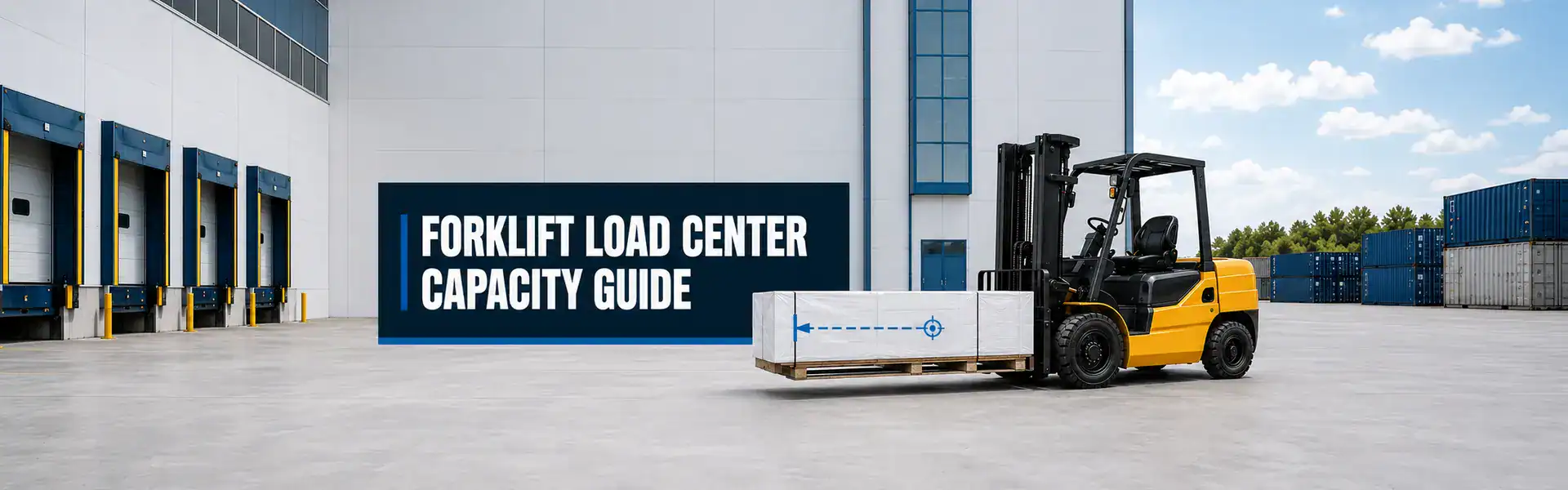
The horizontal load center is the distance from the vertical face of the forks to the load’s center of gravity. The center of gravity is the point at which the load’s weight can be treated as concentrated for stability analysis. For an evenly distributed rectangular load, it is normally near the geometric center.
If an evenly distributed palletized load measures 1,000 mm in the direction of the forks, its theoretical horizontal load center is 500 mm. If that dimension increases to 1,200 mm, the theoretical center becomes 600 mm. This simple half-length method works only when the weight is evenly distributed and the load sits against the fork face. It is not reliable for a machine with a heavy motor at one end, a liquid that can move, stacked products of different weights or a pallet held away from the fork face.
Load center is also not the same as fork length. Longer forks may support a longer pallet, but they do not move the load’s center of gravity closer to the truck. If longer forks encourage the load to sit farther forward, the effective load center can increase. Buyers should record both fork-direction load depth and the real location of the center of gravity.
Rated, Actual and Residual Capacity Are Different
| Term | What it describes | What can change it | What the buyer should verify |
|---|---|---|---|
| Rated capacity | The manufacturer’s stated load under defined reference conditions | Model, rated load center and standard configuration | Capacity plate and specification for the quoted truck |
| Actual load center | The horizontal distance from the fork face to the real load center of gravity | Load depth, weight distribution, placement and packaging | Dimensioned load drawing, weight data and center-of-gravity information |
| Estimated adjusted capacity | A load-moment screening value when the actual center exceeds the rated center | Rated capacity, rated center and actual center | Use only to identify risk and request a formal capacity check |
| Residual capacity | The permitted load for the exact working configuration and height | Mast, lift height, attachment, fork geometry and truck design | Model-specific plate, capacity chart or written manufacturer confirmation |
A catalogue capacity such as 2.5 ton is therefore a starting class, not a complete application approval. It may describe a standard truck at a stated load center and height. The same truck can have a lower residual capacity with a taller mast, an attachment or a longer actual load center. Conversely, a shorter load center does not authorize the user to exceed the capacity printed on the plate. Capacity may never be increased by reversing the screening formula unless the manufacturer provides an approved rating.
Why Moving the Load Forward Reduces Capacity
A counterbalanced forklift can be understood as a lever around the front axle. The truck body and counterweight act behind the axle, while the load acts in front. The forward effect of the load depends on both its weight and its horizontal distance. This is the load moment:
Load moment = load weight × horizontal load-center distance
A 2,500 kg load at 500 mm creates a simple load moment of 1,250,000 kg-mm. If the same weight moves to 600 mm, the moment rises to 1,500,000 kg-mm, an increase of 20 percent even though the scale weight has not changed. The truck must counter a larger forward effect, so the permissible load needs to fall unless the truck has been rated for that condition.
Screening example: 2,500 kg at 500 mm
Assume a capacity plate states 2,500 kg at a 500 mm load center. The buyer wants to handle an evenly distributed load that is 1,200 mm deep in the fork direction, giving a theoretical 600 mm center. A common moment-based screening calculation is:
Estimated capacity = 2,500 kg × 500 mm ÷ 600 mm = approximately 2,083 kg
This estimate immediately shows that a 2,500 kg load should not be approved at the longer center. It does not prove that 2,083 kg is permitted. The exact truck may have another limit because the calculation does not fully represent the front axle-to-fork geometry, mast deflection, lift height, hydraulic limits, attachment weight or stability testing. Ask for the permitted capacity at 600 mm and the required lift height.
Screening example: an off-center industrial load
Consider a 1,800 kg machine on a 1,000 mm-deep base. Treating the center as 500 mm would be wrong if a heavy drive unit places the actual center of gravity 650 mm from the fork face. Against a truck rated at 2,000 kg at 500 mm, the simple screening value would be about 1,538 kg. Although the machine is shorter than some pallets, its weight distribution makes it unsuitable for that assumed rating. A drawing from the load manufacturer or a verified center-of-gravity location is needed.
How to Determine the Real Load Center
Start by defining the direction in which the load will enter the forks. The load depth parallel to the forks, not its longest overall side by default, is the dimension used for the basic center calculation. For a uniform load sitting against the fork face, divide that depth by two.
Then check whether the uniform-load assumptions are true:
- Does the load sit fully against the fork face or load backrest?
- Are the goods evenly distributed across the pallet and along the fork direction?
- Does one end contain a motor, gearbox, coil, tank or dense component?
- Can liquid, granular material or suspended content shift during travel or braking?
- Does packaging, a clamp or another interface hold the load forward?
- Is there overhang beyond the pallet, and is the overhang heavier on one side?
For an irregular load, do not guess its center from outside dimensions. Request the center-of-gravity location from the equipment or load supplier. A useful drawing shows total weight, three-dimensional dimensions, lifting pockets, permitted fork entry, support points and horizontal and vertical center-of-gravity coordinates. Side-to-side offset also matters because a load can remain within its theoretical forward center while moving the combined center of gravity toward the edge of the truck’s stability area.
Load Center Is Not the Only Derating Factor
Lift height and mast configuration
Capacity can decrease as the load is raised. A taller mast changes structural and stability conditions, and different mast stages may have different permitted loads. Ask for capacity at the highest required fork elevation, not only at floor level or the standard lift height. A machine capable of reaching the rack does not necessarily retain its nominal capacity there.
Attachments and effective forward distance
Sideshifters, fork positioners, clamps, rotators and other attachments add weight and can move the load forward. Their effect cannot be handled by subtracting attachment weight alone. The attachment’s mass, own center of gravity, effective thickness and interaction with the truck all matter. The truck should have capacity information that identifies the installed attachment and resulting permitted load.
Fork extensions and nonstandard forks also need review. They may change how the load is supported and where it can be placed. They do not create extra truck capacity. Any modification that affects capacity or safe operation should be approved and reflected in the relevant truck information before use.
Load placement, tilt and operating conditions
A gap between the load and fork face increases the actual center. Forward mast tilt at height, uneven ground, turning, braking and gradients introduce forces that a static moment example does not capture. Operators should keep stable loads properly positioned, travel with the load at the appropriate low transport position and follow the truck manual, site rules and local training requirements. Selection calculations must not be treated as operating instructions.
What Current Anxing Ratings Show
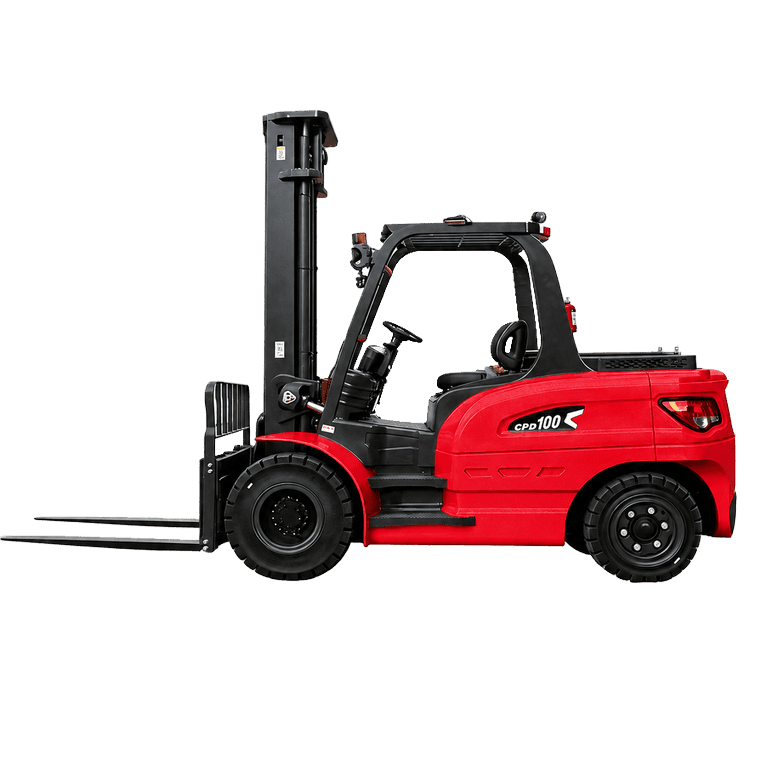
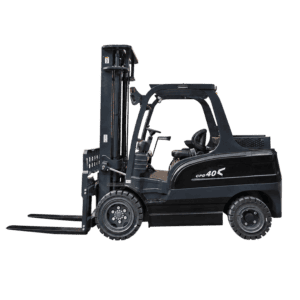
Anxing’s current product pages illustrate why capacity and load center must be read together. The 2–3.5 ton diesel forklift range lists rated-capacity classes from 2,000 to 3,500 kg with a 500 mm load center and a 3,000 mm standard lift height. Those three figures form one reference condition; the tonnage alone is incomplete.
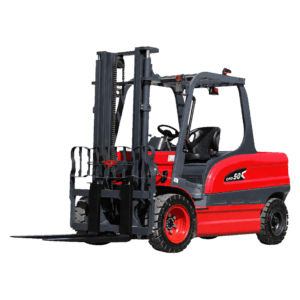
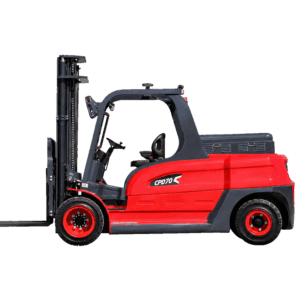
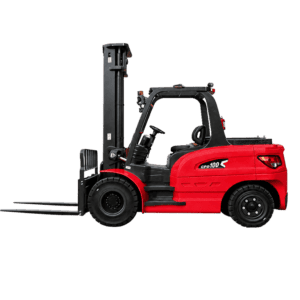
In the next class, the 4–5 ton diesel forklift range lists the 4,000 kg configuration at a 500 mm center, while the 5,000 kg class is available with 500 or 600 mm load-center configurations. For larger loads, the 6–10 ton heavy-duty diesel forklift range states a 600 mm load center. Anxing’s 10 ton electric forklift likewise lists 10,000 kg at a 600 mm center with a 3,000 mm standard lift height.
These examples do not mean that every 500 mm or 600 mm load is automatically approved. The buyer must still confirm the required lift height, actual center of gravity, fork length, mast, attachment and operating conditions for the quoted machine. They do show why comparing only “3.5 ton,” “5 ton” or “10 ton” can produce a poor shortlist. A lower nominal class at the wrong center may be unsuitable, while a configuration rated at the buyer’s real center can provide a clearer basis for selection.
A Practical Capacity-Confirmation Workflow
- Record the maximum complete load weight. Include the pallet, container, packaging, fixture and any material that travels with the load.
- Measure the fork-direction depth. State every load orientation the operation may use rather than only the pallet’s nominal dimensions.
- Locate the center of gravity. Use half the load depth only for a uniform load positioned against the fork face; obtain a drawing for irregular equipment or uneven goods.
- Define the highest placement point. Provide the top rack support level, pallet height and clearance so the required fork elevation can be confirmed.
- Specify the load-handling device. List standard forks, fork length, sideshifter, positioner, clamp, rotator, extensions or other equipment.
- Check every load family. The heaviest load is not always the controlling case; a lighter but longer or more offset load can create the larger moment.
- Use the moment calculation only as a filter. If the actual center exceeds the rated center, reduce the shortlist and request configuration-specific information.
- Match the capacity plate to the delivered truck. Confirm model, serial identity, mast, tire and attachment information and make sure the plate is legible.
- Control changes after delivery. Recheck capacity before adding an attachment, changing fork geometry or introducing a new long or irregular load.
This workflow should sit inside the broader selection process described in Anxing’s forklift buying guide. A correct capacity configuration still needs to fit the aisle, doorway, surface, duty cycle, power system and destination requirements.
What to Send in a Forklift Capacity RFQ
A request for “one 3-ton forklift” is not enough to confirm capacity. Send a compact application package containing:
- maximum weight of each load, including pallet or fixture;
- length, width and height, with the fork-entry direction marked;
- horizontal and vertical center-of-gravity location for uneven or irregular loads;
- photos of the load, pallet underside and fork pockets;
- required fork length, width, spacing and load backrest needs;
- highest required fork elevation and lowest overhead restriction;
- all requested attachments and whether side shift is required;
- aisle, doorway, surface, slope and indoor or outdoor conditions;
- daily operating hours, load cycles and power preference;
- quantity, destination country and documents required with the order.
Ask the quotation to state the rated capacity, rated load center, mast and lift height, fork dimensions, installed attachments and the capacity information that will accompany the machine. If the order is imported, keep the approved specification aligned from quotation through production, pre-shipment inspection and delivery; Anxing’s forklift import checklist explains how to control that handoff.
Common Load-Center Buying Mistakes
Selecting by load weight alone
Two loads weighing 2,000 kg can demand different trucks when one is 1,000 mm deep and the other is 1,500 mm deep or heavily weighted at the front. Include weight, geometry and center of gravity in the same comparison.
Assuming fork length solves a long-load problem
Forks must adequately support the load, but longer forks do not cancel the additional moment created by a forward center of gravity. Support and capacity are separate checks.
Using a simple formula as the final rating
The formula can reject an obviously unsuitable case, but it cannot create a certified capacity for a particular mast and attachment combination. Final approval comes from model-specific manufacturer information.
Ignoring the highest lift condition
A truck may move a load near floor level yet have insufficient residual capacity at the top rack. Request the permitted load at the real center and highest required elevation.
Reusing an old plate after configuration changes
An attachment or altered fork arrangement can make the original capacity information inapplicable. Keep the plate and configuration records matched to the truck as actually operated.
Load center turns a nominal tonnage into an application-specific decision. Measure where the weight truly acts, compare every load family, and confirm capacity at the required height with the exact handling configuration. That process gives buyers a defensible basis for choosing a forklift and prevents a low-detail quotation from becoming an expensive capacity mismatch.