Key Takeaways
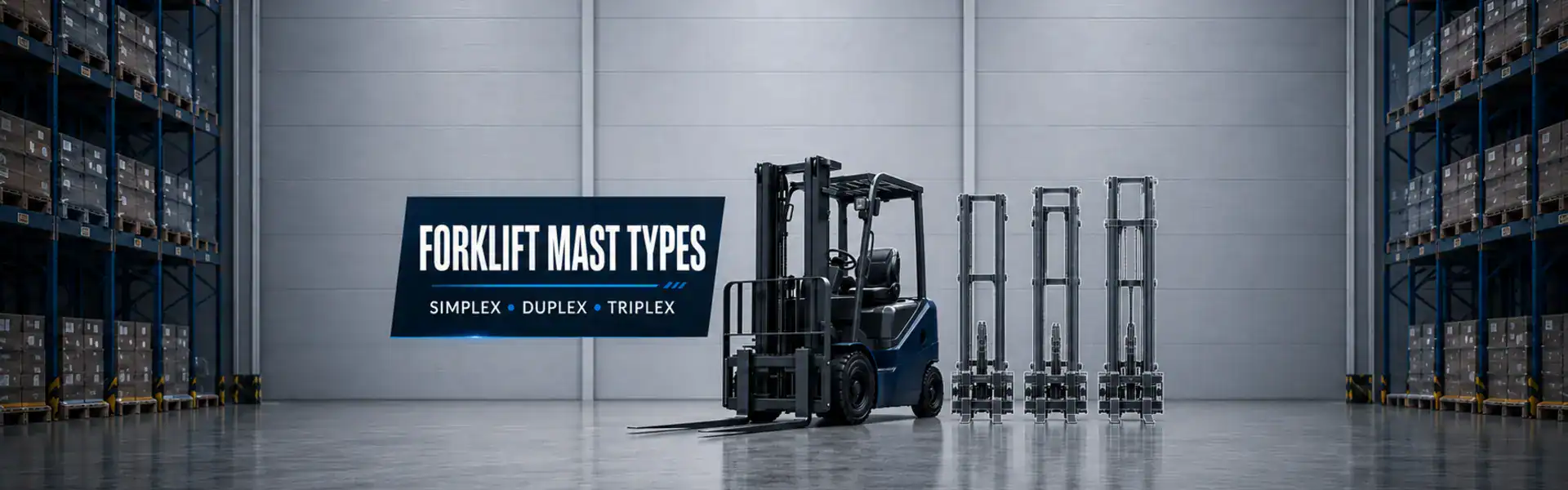
- Simplex masts suit lower lift tasks, duplex masts cover many general loading and stacking applications, and triplex masts combine higher reach with a relatively compact lowered profile. Choose by maximum fork height, lowered height, free lift, raised height and residual capacity—not by the mast name alone.
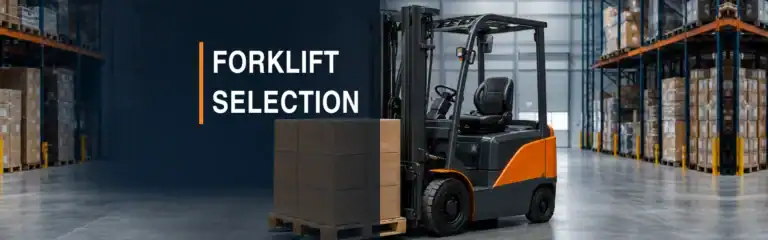
Start with the complete handling task in the Anxing forklift selection guide, then use the process below to specify the mast without relying on a stage name alone.
What Is a Forklift Mast?
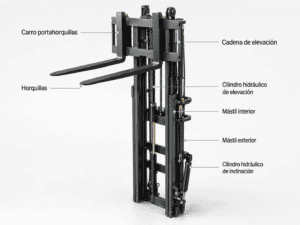
The mast is the vertical lifting assembly at the front of a forklift. It guides the carriage, forks and load as hydraulic cylinders, chains and nested rails raise or lower them. The mast can also tilt on many counterbalanced forklifts, but tilt angle is a separate specification from lift height and mast stage count.
Terms are not perfectly consistent across manufacturers and markets. One specification may call a mast “two-stage,” another may use “duplex,” and a third may distinguish a standard two-stage mast from a two-stage full-free-lift mast. Likewise, triplex may appear as three-stage, triple-stage or full-free-lift three-stage. The name should therefore lead to a mast data table, not replace it.
Ask the supplier for a drawing or table covering the proposed mast on the exact forklift model. This is especially important when a buyer requests a non-standard lift height, an attachment, a different load backrest or a configuration intended for containers and low doorways.
Four Mast Dimensions That Decide Whether the Forklift Fits
Maximum lift height often receives all the attention in an RFQ. The other three measurements can stop the job just as quickly. Use the following terms as a coordinated vertical envelope.
| Measurement | What it describes | Where it matters | Common buying error |
|---|---|---|---|
| Maximum fork height (MFH) | Highest vertical position the fork-supporting surface can reach | Top rack beam, stacking level and load placement clearance | Matching it exactly to the beam without room to lift the pallet clear |
| Overall lowered height (OALH) | Height of the mast with its sections fully collapsed | Doorways, containers, trailers, mezzanines and shipping | Checking the overhead guard but overlooking a taller collapsed mast |
| Free lift or free fork height | Distance the forks can rise before the mast sections increase the truck’s total height | Lifting inside containers, trailers and other low-roof spaces | Assuming every duplex or triplex mast provides the same free lift |
| Overall raised height (OARH) | Highest point of the extended mast, and sometimes the load backrest where applicable | Ceilings, beams, sprinklers, lighting and roof structures | Checking fork height but not the structure extending above it |
The site measurement must use the lowest real obstruction, not only the nominal ceiling height. Include sprinkler pipes, lighting, door tracks, rack beams, heaters and any pallet or load projection. Where tolerances are tight, provide a dimensioned layout and photographs rather than relying on a verbal description such as “standard container” or “normal warehouse door.”
Simplex Mast: Simple Structure for Lower Lift Tasks
A simplex, or single-stage, mast has the fewest lifting stages in this comparison. It generally suits applications that do not require high stacking. Its simpler rail arrangement can support a relatively open forward view and a straightforward structure, but the exact visibility depends on cylinders, chains, hoses, carriage and load backrest design.
Simplex masts are often associated with low-level handling, ground-to-platform transfer and equipment classes with limited lift requirements. They can be a practical starting point where the truck works mainly outdoors or in an open building without restrictive overhead structures. However, “simplex” does not automatically mean the lowest possible collapsed height, and it should not be assumed to provide useful full free lift.
Choose this type only after confirming that its maximum fork height clears every required placement point. A buyer who expects future racking changes may outgrow a low-lift mast even if it handles the current job. Conversely, paying for extra mast stages that are never used can add unnecessary structure and service items.
Duplex Mast: Two Stages for General Handling
A duplex mast uses two lifting stages. It is a common choice for general loading and stacking where moderate lift reach is required. Depending on the design, it may include a dedicated free-lift cylinder that allows the carriage and forks to rise before the inner mast rail extends above the collapsed profile.
This is where terminology becomes important. Some suppliers use “duplex” to mean a two-stage full-free-lift mast, while others list a standard two-stage mast and a two-stage full-free-lift version separately. If the forklift must lift inside a container or trailer, request the actual free-lift value. Do not accept “duplex” as proof that the forks can reach the required pallet level without the mast rising into the roof.
A duplex mast can be appropriate for loading docks, manufacturing supply routes, lower racking and outdoor industrial handling. Compared with a taller multi-stage arrangement, it may offer a less complex visual field and a suitable structure for work that does not need extreme reach. These are class-level tendencies, not guarantees for every model.
Triplex Mast: Three Stages for High Racking and Restricted Access
A triplex mast uses three lifting stages. The nested sections allow a higher maximum fork height while retaining a more manageable collapsed profile than a high-lift mast with fewer stages might require. Many triplex designs also provide substantial free lift, making the configuration relevant when one truck must enter a lower doorway and then stack into higher racking.
The additional stage does not make triplex universally superior. More rails, rollers, chains and hydraulic components can affect forward visibility, inspection points, service work and mast weight. A high-lift configuration can also have lower permitted capacity at the top of the mast than the truck’s nominal ground-level rating suggests.
Triplex is therefore a strong candidate for high-bay warehouses, mixed loading-and-racking work and sites with a low access opening followed by a higher storage zone. It remains necessary to confirm overall raised height against ceiling services and to obtain residual-capacity information for the exact lift height and attachment.
What About a Quad Mast?
A quad, or four-stage, mast adds another nested stage for specialized very-high-lift applications. Buyers may encounter it while researching forklift mast types, but it should not be treated as the automatic upgrade from triplex. Additional reach can bring more mast components, more restricted sight lines and a demanding capacity check at height.
If the required fork height exceeds the practical triplex range available for the selected truck, compare a model-specific quad configuration with other high-lift equipment classes. Confirm the collapsed and raised dimensions, free lift, residual capacity, maintenance support and actual warehouse layout before deciding.
Simplex vs. Duplex vs. Triplex: Decision Comparison
| Decision factor | Simplex | Duplex | Triplex |
|---|---|---|---|
| Stages | One | Two | Three |
| Typical selection signal | Lower lift task with few overhead constraints | General stacking and loading at moderate heights | Higher racking or combined low-entry and high-lift requirements |
| Free lift | Often limited; verify exact value | May be substantial, especially in full-free-lift designs | Often substantial, but configuration-specific |
| Collapsed profile at comparable high reach | Not usually selected for high reach | May become tall as required lift height increases | Can package greater reach into a compact lowered envelope |
| Forward-view tendency | Potentially more open | Balanced, depending on cylinder and rail layout | More nested components may restrict the view |
| Inspection and service | Fewest mast-stage components | Intermediate complexity | More rails, rollers, chains and staging components |
| What must still be confirmed | MFH, OALH, free lift, OARH, residual capacity, visibility, load backrest, attachments and model-specific availability | ||
This table describes common selection tendencies, not fixed Anxing specifications. Two masts with the same stage count can have different heights, cylinder arrangements and free-lift values. Compare the supplier’s mast table line by line for the exact model under quotation.
How Mast Choice Affects Capacity, Visibility and the Working Envelope
Residual capacity at height
A forklift’s nominal capacity does not guarantee the same permitted load at every height. The mast, lift height, load center, forks and attachments form one rated configuration. Taller lifts can reduce the stability margin, while a side shifter, fork positioner or clamp adds weight and can move the effective load center forward.
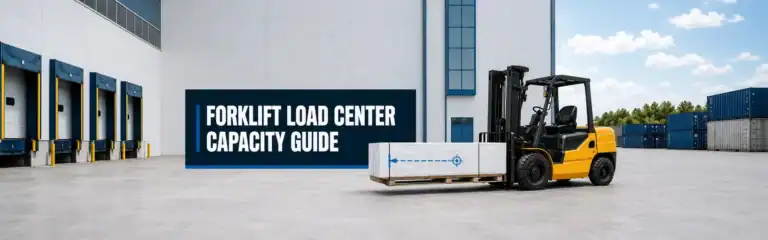
Ask for the permitted capacity at the highest required fork height, not merely the catalog capacity at a standard condition. The method used in our forklift load center guide can identify an obvious early mismatch, but only the manufacturer’s configuration data and capacity plate can confirm the approved value.
Forward visibility
Mast rails, lift cylinders, chains, hoses, carriage and load backrest occupy the operator’s forward field. A multi-stage mast can introduce more visual obstructions, although good component placement may preserve useful sight lines. Visibility should be evaluated with both empty forks and the actual load, because the load itself may be the largest obstruction.
Travel and overhead clearance
A mast that clears the entrance when fully lowered may still contact an overhead structure when the operator raises the forks. This is particularly relevant inside trailers and containers. The operator needs a clearly defined lifting envelope and must follow the supplied operating instructions; free lift is a configuration feature, not permission to work without checking roof clearance.
Match the Mast to the Real Application
Container or trailer work
Record the lowest clear entrance height and the lowest internal roof obstruction. Then state how high the forks must rise while the truck remains inside. A compact overall lowered height gets the forklift through the opening; adequate free lift lets it raise a pallet without the mast sections extending into the roof. Both values are required.
General warehouse racking
Measure the highest supporting beam, pallet base and clearance required to lift and place the load. Also check the fully extended mast against sprinklers, lights and roof members. If the route passes through a low doorway before reaching higher racking, a triplex or another compact high-lift configuration may be appropriate, subject to residual capacity.
Outdoor yards and production areas
Where lift height is modest and overhead clearance is generous, a duplex or lower-stage arrangement may meet the job without unnecessary reach. Surface, tires, power system and duty cycle remain separate decisions. The mast type does not make a standard industrial truck suitable for loose or severely uneven terrain.
High lifts with attachments
Specify the attachment before the mast and capacity are approved. A side shifter, fork positioner, clamp or rotator can change carriage thickness, load position, visibility and residual capacity. The final data plate or capacity information should match the supplied attachment and mast combination.
How Current Anxing Forklift Ranges Illustrate the Decision
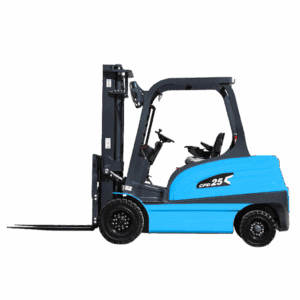
The current Anxing 1.5–3.5 ton electric forklift lists a 3,000 mm standard lift height. Its product page invites buyers who need a different mast to include that requirement for configuration and capacity confirmation. This range is relevant for warehouse evaluation, but the published 3,000 mm figure alone does not identify simplex, duplex or triplex, nor does it define free lift.
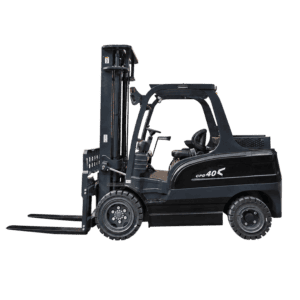
The Anxing 2–3.5 ton diesel forklift range lists a 3,000 mm standard lift and customizable lift-height options from 3 to 6 m. The 6–10 ton heavy-duty diesel range also lists 3,000 mm as standard and 3–6 m as the available customizable range.
These verified ranges show why a buyer should not order “a six-meter mast” as a complete specification. For the chosen capacity class and height, Anxing still needs to confirm the available mast stage, collapsed and raised dimensions, free lift, fork and attachment package, and permitted capacity at the operating height. A heavy-duty truck may also require a different mast structure and capacity analysis from a light warehouse forklift, even when the requested fork height is the same.
A Practical Forklift Mast Selection Process
- Define the highest placement point. Record the top supporting surface, pallet base and clearance needed to enter or leave the rack safely.
- Measure every access height. Include doorways, container openings, trailer roofs, dock shelters, mezzanines and elevator doors.
- Find the lowest overhead obstruction. Note sprinklers, lighting, beams, heaters, door tracks and hanging services in both travel and lift zones.
- State where lifting must occur. Explain whether the forks must rise inside a container, under a mezzanine or only after the truck enters an open area.
- Calculate the required free lift. Use the pallet level required in the restricted space, then ask for a model-specific free-lift figure rather than a general mast label.
- Confirm the real load. Provide maximum weight, dimensions, load center, pallet orientation and any unusual center-of-gravity information.
- Add forks and attachments. Include fork length, side shift, fork positioner, clamp or other equipment before residual capacity is checked.
- Compare complete mast-table rows. Review MFH, OALH, free lift and OARH for each candidate, along with visibility and service access.
- Approve the rated configuration. Obtain the final specification and capacity information for the exact truck, mast, height, forks and attachment supplied.
If the clearance margin is small, allow for floor variation, thresholds, tire condition, mast tilt, load movement and measurement error. The forklift should not depend on a theoretical zero-clearance fit. Site rules and the final equipment manual should govern operation.
What to Include in a Forklift Mast RFQ
Send a supplier enough information to evaluate the vertical task, load and route together:
- forklift type and preferred power system;
- maximum and typical load weights;
- load length, width, height, pallet type and fork-entry direction;
- required maximum fork height and top rack-beam height;
- lowest doorway, container, trailer and internal overhead clearances;
- fork height required while working under the lowest roof;
- required fork length, load backrest and attachments;
- aisle and turning constraints, surface and gradients;
- daily operating hours, shifts and indoor or outdoor use;
- quantity, destination and required documents.
Request a mast table or drawing for the quoted option and ask the supplier to state the stage count, free-lift arrangement and all four vertical dimensions. Where the application involves high racking or long loads, request residual-capacity confirmation at the actual height and load center.
Choose the Vertical Envelope, Not Just the Mast Name
Simplex, duplex and triplex are useful starting categories. Simplex suits lower lift requirements, duplex covers many general loading and stacking tasks, and triplex packages greater reach into a relatively compact collapsed profile. None of these descriptions proves that a forklift fits a particular doorway, container, rack or load.
The reliable decision is made from maximum fork height, overall lowered height, free lift, overall raised height and permitted capacity at the working height. Match those values to measured site limits, then confirm the final mast, forks and attachments in the quotation and capacity documentation.