Key Takeaways
- Choose solid tires for puncture-prone prepared surfaces when uptime matters more than cushioning. Choose air-filled pneumatic tires for uneven routes where shock absorption and traction are more important. Always confirm tire, rim and forklift-model compatibility before ordering.
The final choice must match the truck as well as the floor. Tire size, rim, chassis clearance, load rating and the forklift manufacturer’s approved configuration all matter. A tire that fits the rim is not necessarily approved for the machine. Start with the complete task in the Anxing forklift selection guide, then define the tire requirement.
First, Clarify the Forklift Tire Terminology
“Pneumatic” can describe a tire’s profile as well as its construction. An air-filled pneumatic tire contains compressed air and behaves much like a commercial vehicle tire. A solid resilient tire is made from solid rubber layers but may have the same general external profile as a pneumatic tire. Some suppliers call this a “solid pneumatic” tire, even though it contains no air.
A press-on cushion tire is another solid construction: a rubber band bonded to a steel base and pressed onto a compatible wheel. It is common on compact industrial trucks designed for smooth floors, but it should not be treated as a direct substitute for a resilient or air-filled pneumatic tire. Foam-filled pneumatic tires are another possible category; they reduce flat risk but change ride, weight and heat behavior. The quotation should state the exact construction, not only “solid” or “pneumatic.”
Solid vs. Air-Filled Pneumatic Tires at a Glance
| Decision factor | Solid resilient tire | Air-filled pneumatic tire |
|---|---|---|
| Puncture risk | Cannot lose air; strong candidate around scrap, nails and sharp waste | Can be punctured or lose pressure; route control and inspection are important |
| Shock absorption | Less cushioning; more vibration may reach the truck, load and operator | Air chamber absorbs more surface shock when correctly inflated |
| Surface fit | Usually strongest on firm, relatively even industrial surfaces | Often better for uneven paved yards and rougher outdoor routes |
| Traction | Depends on tread, compound, load and surface; not guaranteed by construction alone | Can provide useful grip and ground conformity with the correct tread and pressure |
| Routine attention | No inflation checks, but wear, chunking, cuts and heat damage still require inspection | Requires pressure checks plus inspection for leaks, cuts, tread wear and damage |
| Duty-cycle concern | Heat can build during long, fast or heavily loaded travel cycles | Underinflation can increase heat, wear and instability risk |
| Typical selection signal | Puncture-prone prepared site where uptime outweighs ride comfort | Uneven route where cushioning and traction outweigh puncture exposure |
These are class-level tendencies, not model specifications. Tread pattern, rubber compound, tire width, pressure, axle load and route conditions can change the result. Compare approved options for the exact forklift rather than applying the table to an incompatible chassis.
When Solid Forklift Tires Make More Sense
Solid resilient tires are attractive where an air leak could stop production: recycling plants, metalworking areas, waste-handling routes, timber yards and construction-material facilities may expose tires to nails, wire, metal fragments or sharp pallet debris. Removing pressure maintenance also simplifies one inspection item for a fleet, although it does not eliminate tire inspection.
The best solid-tire route is still firm and reasonably even. On broken concrete, potholes and repeated dock impacts, the reduced cushioning can transfer more shock into bearings, mast components, the load and the operator. Fragile goods may also experience more vibration. A buyer should consider route repair before using tire selection to compensate for severe floor damage.
Long travel is another qualification. Solid rubber flexes and creates heat. Frequent high-speed runs, heavy loads, tight cornering and limited cooling time can accelerate heat-related wear. If the truck operates continuously rather than performing short intermittent moves, provide route length, average load and shift pattern to the supplier instead of assuming puncture resistance makes solid tires the lowest-cost choice.
When Air-Filled Pneumatic Tires Are the Better Starting Point
Air-filled pneumatic tires normally offer better cushioning over expansion joints, coarse pavement and uneven yard surfaces. That can reduce shocks to the truck and carried goods while improving operator ride. A suitable tread may also help on wet or loose surfaces, but tread choice must match the actual ground; aggressive tread does not turn a standard industrial forklift into a rough-terrain machine.
The tradeoff is pressure and puncture management. Underinflation changes the tire’s shape, raises rolling resistance and heat, and can affect handling. Overinflation reduces cushioning and changes the contact patch. Pressure must follow the tire and truck specification, with checks performed under the site’s inspection procedure. Cuts, embedded objects and damaged valve components also need attention before operation.
Pneumatic tires are therefore a practical starting point for maintained outdoor yards, mixed indoor-to-outdoor routes and loads that benefit from reduced shock, as long as sharp debris is controlled. If repeated punctures are already causing downtime, the site should compare route housekeeping, a verified solid option and any approved filled-tire alternative rather than continuing with the same setup.
Seven Worksite Factors That Should Decide the Tire
1. Surface condition, not simply indoor or outdoor
A smooth outdoor apron may suit a solid-tire industrial truck, while a damaged indoor recycling floor may favor puncture protection but create excessive vibration. Record concrete joints, thresholds, ramps, potholes, gravel, mud and the worst section of the route. The harshest frequent section often controls the decision.
2. Sharp-debris exposure
List nails, wire, metal swarf, broken pallets and demolition waste separately from ordinary surface roughness. Solid tires address air loss, but they can still suffer cuts, chunking and tread damage. Pneumatic tires need a route-cleaning and inspection plan where debris cannot be fully removed.
3. Travel distance and duty intensity
Provide the distance of a typical loaded run, trips per hour, shift length, average speed and rest periods. Short pallet positioning and repeated long shuttles impose different thermal demands. Duty intensity also affects rolling resistance, energy or fuel use and replacement timing.
4. Load sensitivity and operator exposure
Glass, finished components, electronics and unstable loads may need better shock control. Operators making long daily runs also experience the route differently from those completing short loading cycles. Tire choice cannot replace a suitable seat, speed control or route maintenance, but it influences transmitted vibration.
5. Traction, slopes and weather
Describe grades, wet areas, contaminants, yard drainage and seasonal conditions. Tire construction alone does not guarantee grip. Tread pattern, compound, wear level, surface material and operating technique all contribute. Steep slopes or loose ground may require a different forklift class.
6. Cleanliness and marking requirements
Food, pharmaceutical and finished-floor applications may request non-marking tires. Non-marking is a compound option, not a synonym for pneumatic or solid. Conductive or antistatic requirements are also separate specifications and should be confirmed for the destination’s application and rules.
7. Truck and rim compatibility
Confirm the complete tire designation, rim size, axle position, approved load and speed ratings, clearance and any effect on ground clearance or overall height. Changing tire type may alter ride height and stability characteristics. Obtain written configuration confirmation rather than authorizing a conversion from dimensions alone.
What Current Anxing Forklift Options Show
The current Anxing 2–3.5 ton diesel forklift range publishes pneumatic tires as standard and solid tires as an option. The 4–5 ton diesel forklift range states the same choice. This allows a buyer to compare tire construction while keeping the capacity class, route and approved model configuration in view.
These product-page options do not mean both constructions deliver identical results on every route. A 2,000 kg truck making short factory moves has a different tire duty from a 5,000 kg truck shuttling materials across a large yard. The quotation should therefore name the tire option, size and tread for the selected model rather than stating only “solid tires optional.”
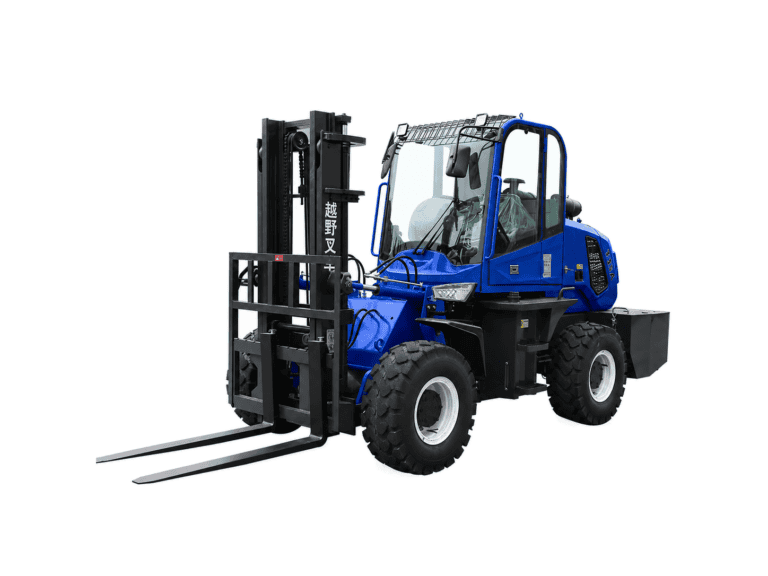
For loose, rutted or seriously uneven ground, review the truck class as well as the tire. The current Anxing 2–3.5 ton rough-terrain forklift range lists four-wheel drive, 180–230 mm ground clearance depending on model, and model-specific large tire sizes. Its published page does not identify every tire construction, so that detail must be confirmed in the quotation. The important lesson is that traction, clearance, driveline and chassis geometry may matter more than fitting an aggressive tire to a standard industrial truck.
A Practical Tire-Selection Process
- Map the full route. Photograph and measure the worst joints, slopes, thresholds and ground sections, including indoor-to-outdoor transitions.
- Separate puncture risk from roughness. Debris favors puncture-proof construction; roughness favors cushioning. If both are severe, the site may need route improvement or a different truck class.
- Define the actual load. Record maximum and typical weight, dimensions, load center and sensitivity to shock.
- Quantify duty intensity. State travel distance, trips per hour, speed limits, hours per shift, number of shifts and cooling periods.
- Set environmental requirements. Include wet use, temperature, hygiene, floor marking, conductive needs and any regulated site conditions.
- Shortlist only approved configurations. Compare tire construction, size, tread, compound, rim and ratings available for the exact forklift model.
- Evaluate maintenance and downtime together. Compare pressure checks and puncture response with solid-tire wear inspection, heat exposure and replacement capability.
- Confirm the quotation. Require the final tire specification by axle and ask whether the supplied configuration changes clearance, capacity information or recommended operating limits.
What to Include in Your Forklift Tire RFQ
A useful request should include the forklift type and capacity, maximum load, route photos, surface description, gradients, indoor or outdoor use, sharp-debris exposure, loaded travel distance, hours and shifts, speed policy, puncture history, temperature, wet conditions and marking requirements. Also provide the destination, quantity and any preferred tire brand or local replacement constraint.
Ask the supplier to return the construction, size, tread pattern, compound, load and speed rating, rim specification and approved inflation pressure where applicable. For solid tires, ask whether the proposed duty and travel cycle fall within the tire supplier’s recommendations. For pneumatic tires, define inspection intervals and a practical repair or spare-tire plan for the site.
Choose for the Route, Then Confirm the Truck
Choose solid tires when punctures are the dominant operational risk and the forklift works mainly on firm, prepared surfaces. Choose air-filled pneumatic tires when cushioning, ground conformity and outdoor traction are more important and the site can control pressure and puncture risk. Where ground is genuinely loose or severely uneven, compare a purpose-built rough-terrain forklift instead of asking tires to solve a chassis problem.
The defensible decision combines the route, load, duty cycle and maintenance plan with a model-approved tire and rim configuration. Put the full tire designation in the quotation so the delivered forklift and future replacements match the worksite decision.