Puntos clave
- It may. Turn the pallet over and compare its entry openings, bottom boards and fork path with the exact forks and support legs on the quoted stacker. Then review the loaded center of gravity, rack approach and aisle. A pallet name or outside size by itself is not an approval.
Sometimes—and “standard pallet” is not enough information to know.
An electric pallet stacker can handle a pallet only if the forks can enter fully, the machine’s support legs have a clear path, and the loaded pallet stays within the permitted load-center and lift conditions. The pallet must also reach its rack position without the truck’s legs meeting a floor rail, upright, or bottom beam.
This is where many enquiries go wrong. A buyer sends “1,200 × 800 mm, 1,000 kg.” The supplier sees a familiar size and starts discussing capacity. Neither side has looked at the underside. If a bottom board crosses the path of the stacker’s load arms, the forks may enter while the rest of the machine cannot. The capacity is adequate; the pallet still cannot be picked up correctly.
A useful pallet stacker pallet compatibility review therefore starts with an underside photograph, not a pallet name.
The Top View Is the Wrong Place to Start
Outside dimensions tell us how much floor and rack space a pallet occupies. They say little about what happens as the stacker moves into it. Two pallets with the same length and width can have different blocks, stringers, bottom boards, moulded ribs, or fork tunnels. One accepts the proposed machine. The other stops the support legs before the forks reach their working position.
Turn over an empty representative pallet safely, or obtain its technical drawing. A straight photograph from below is ideal. Add a tape measure and mark the face the operator will approach. That last detail matters: a four-way pallet may be accessible from every side with a counterbalanced forklift, yet give a stacker a different support-leg path from each direction.
| Information | Por qué es importante | What can go wrong |
|---|---|---|
| Entry face | Sets the pallet dimension that runs along the forks and the route taken by the support legs | The truck is reviewed from a side the warehouse cannot actually use |
| Smallest clear opening height | Must accept the fork blade and any structure entering below the pallet | A low board, rib, repair plate, or distorted runner blocks entry |
| Opening width and spacing | Must match individual fork width and usable fork spread | The fork pair aligns with the pallet, but each blade is too wide for its pocket |
| Blocks, stringers, and bottom boards | Define the floor-level path available to load arms and wheels | The forks enter while a load arm meets a solid part of the base |
| Overall pallet depth | Affects fork support and the load center | Short forks leave poor support, or longer forks project behind the pallet |
| Loaded dimensions and weight | Determine the real center of gravity and the space swept during a turn | Overhang or uneven weight makes the supplier’s original assumption invalid |
Measure the smallest usable opening rather than the cleanest-looking one. Plastic runners can bow. Wooden boards can sag. A repair block or protruding fastener may reduce the space locally. If the pallet pool contains several versions from different suppliers, photograph each underside pattern. Approving the best sample does not approve the fleet.
What Sits Beneath the Pallet During a Lift?
The answer depends on the stacker layout. Product names are not always used consistently across markets, so the geometry is more useful than the label.
On a fork-over or fixed-leg stacker, the load arms sit below the lifting forks. It is compact because the supporting structure follows the load, but the pallet needs an open route at floor level. A transverse bottom board can occupy exactly the space required by those arms. Changing fork length will not remove that conflict.
A straddle stacker sends its support legs around the outside of the pallet while the forks lower between them. This can make a closed-bottom pallet workable, provided the inside distance between the legs exceeds the pallet or load width with suitable clearance. The legs still need to fit beneath or around the rack. Adjustable straddle legs broaden the usable range, but they have limits and make the truck wider in operation.
A counterbalanced stacker has no long load arms beneath or around the pallet. Counterweight behind the mast supports the forward load, allowing the forks to approach pallet bases that would obstruct a support-leg machine. That flexibility comes with a longer or heavier chassis and often a different aisle requirement. It is an alternative to review, rather than an automatic upgrade.
Ask the supplier for a simple plan view of the forks, legs, and wheels. Place it over the pallet drawing at the intended entry face. A marked-up drawing usually settles the issue faster than a long email exchange about whether the pallet is “open” or “closed.”
Pallets That Deserve a Closer Look
Euro pallets. An EPAL Euro pallet has nominal dimensions of 800 × 1,200 mm and four-way access. It is familiar equipment, but the entry direction still changes which dimension runs along the forks. Bottom boards, block positions, fork length, and the path of the stacker’s support arms remain part of the review. “Euro pallet compatible” should describe a confirmed configuration, not an assumption based on 800 × 1,200 mm alone.
48 × 40 inch pallets. This description may refer to block or stringer construction, and the usable entries may not be equivalent. A notched stringer can admit forks from the side while leaving less room than a full opening. The warehouse also needs to state whether the 48-inch or 40-inch face is presented to the truck. Converting the outside dimensions to millimetres without describing the base leaves the important question unanswered.
Plastic pallets. Their underside geometry varies widely. Some have clear runners; others use dense ribbing, moulded feet, anti-slip inserts, or enclosed tunnels. The opening may look generous at the face and narrow farther inside. A manufacturer’s drawing is particularly useful here because a photograph does not always show internal taper or reinforcement.
Reversible and closed-bottom pallets. A lower deck can improve pallet strength or allow stacking, yet it removes the open floor-level space used by many compact stackers. Wide straddle or counterbalanced geometry may solve the handling problem. First check whether the resulting truck will still fit the rack and aisle.
Steel stillages, cage pallets, and custom skids need the same treatment. Their fixed pockets may dictate fork width and spacing, while the tare weight and an offset payload can change the capacity calculation. If a stillage was designed for crane handling, do not assume that its base is suitable for forks without confirmation from the carrier’s specification.
The Pallet May Fit Empty and Fail When Loaded
Compatibility is often discussed as though the pallet were the load. In practice, the goods can be the deciding factor.
Consider a 1,200 mm-deep pallet with cartons extending beyond the rear edge. The overhang moves the center of gravity farther from the fork face and increases the space occupied during a turn. Liquids, reels, motors, bagged material, and mixed cartons may put most of the weight away from the geometric center. A catalogue rating based on a stated load center cannot be applied to a deeper or uneven load without review.
Fork length has two jobs: support enough of the pallet and avoid projecting where it can strike another pallet, a wall, or goods behind the rack position. Simply ordering the longest option is poor practice. The proposed fork length, spread, load depth, center of gravity, lift height, and mast configuration belong in one capacity check.
Pallet condition is separate again. Broken boards, loose nails, split blocks, distorted plastic runners, or severe deck deflection can make a previously compatible pallet unsafe or impossible to enter cleanly. The machine should be selected for sound pallets, while the warehouse maintains a process for removing damaged ones.
Then Look Beyond the Pallet
A stacker can collect a pallet from open floor space and still fail at the rack. Its support legs may meet a low horizontal brace, floor guide, upright protector, or raised rail before the pallet reaches the beam. Pallet stops and support bars can also affect fork withdrawal. A rack elevation and a few floor-level photographs are more useful than beam height by itself.
The route adds another set of constraints. Door width is only the start. The loaded truck needs room at right-angle turns, aisle intersections, and the end of each rack row. Pallet orientation and overhang affect that space. Thresholds, dock plates, joints, gradients, and uneven floors affect ground clearance and traction. These issues do not change whether the forks enter, but they can change which stacker layout is practical.
A Practical Review Before You Request a Price
- Separate the pallet types in use. Do not group them by outside dimensions if their undersides differ. Include returnable pallets, export pallets, plastic variants, and the occasional custom skid.
- Choose the real entry face. Base this on the rack, production station, vehicle, or warehouse flow—not on the easiest side to photograph.
- Send an underside drawing or clear photographs. Show opening height and width, pocket spacing, boards, blocks, stringers, runners, and the intended fork path.
- Add the load. Give the maximum gross weight, loaded depth and width, overhang, and any known offset or unstable weight distribution.
- Compare the exact machine geometry. Review fork size and adjustment together with support-leg inside width, outside width, height, and wheel position. Follow the path through the pallet, not just the first few centimetres of entry.
- Finish with capacity, rack, and route. Confirm capacity at the actual load center and lift height, then check the rack approach, working aisle, doors, turns, floor, and gradients. Put the approved configuration and pallet drawing into the quotation.
If the drawing leaves very little clearance, arrange a controlled fit test with the proposed configuration or a representative sample. Small variations in pallet manufacture and wear are normal; a design that works only when every dimension is nominal will cause trouble in daily use.
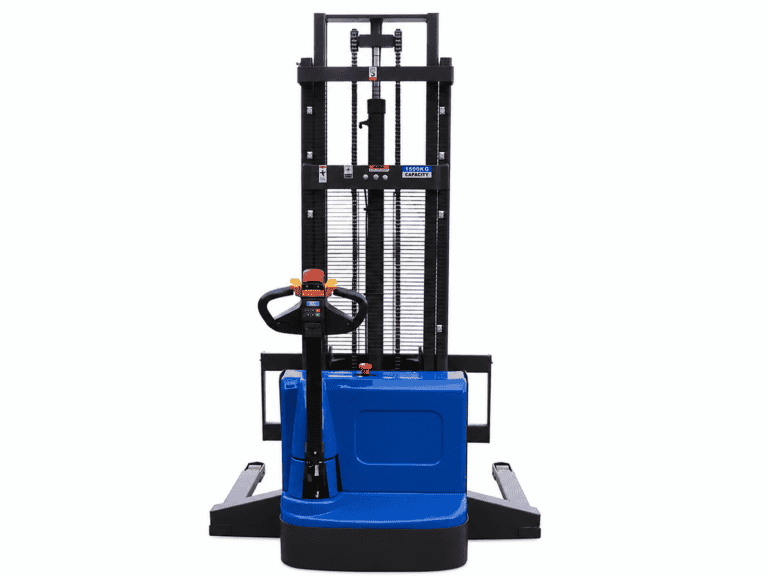
Reviewing the Anxing CDD-1.5T-2T
The current Anxing Apilador eléctrico de paletas con control remoto de 1,5 a 2 toneladas is model CDD-1.5T-2T. Published specifications list configurable rated capacities of 1,500 and 2,000 kg, a 3,500 mm lift height, and fork dimensions of 50 × 160 × 1,150–1,200 mm. Fork length and the overall configuration can be reviewed for the pallet-handling application.
Those numbers are useful, but they do not say that every pallet of a familiar size will fit. The quotation still needs to identify the fork arrangement, usable spacing, support-leg geometry, and capacity conditions for the buyer’s pallet. A closed-bottom plastic pallet and an open block pallet may need different solutions even when their outside dimensions and load weight are identical.
For this model, send Anxing the pallet underside, entry direction, maximum loaded dimensions and weight, required lift height, rack arrangement, aisle, travel route, daily workload, quantity, and destination. If capacity, mast, operator format, battery, or the wider warehouse task is still undecided, the Electric Pallet Stacker Buying Guide covers those choices without replacing the pallet drawing.
Can One Stacker Serve a Mixed Pallet Fleet?
It can, but the least frequent pallet may set the specification.
Suppose most loads use 800 × 1,200 mm block pallets, while inbound material occasionally arrives on a wider closed-bottom plastic pallet. The common pallet may suit a compact fixed-leg machine. The plastic pallet may require wide straddle legs, which change the truck width and rack approach every day—even though that pallet appears only twice a week.
There are three sensible responses. Choose one configuration that passes every pallet and route check. Standardize the pallet pool so the outlier disappears. Or assign the unusual carrier to different handling equipment. The cheapest truck on its own is not necessarily the lowest-cost decision if it forces manual repalletizing or creates a recurring blockage at the rack.
Put the Pallet Interface in the Quotation
A compatibility discussion should end with something more precise than “suitable for standard pallets.” Attach the pallet drawing or photographs. Mark the entry direction. Record the agreed fork dimensions and support-leg arrangement, along with the load and lift conditions used for the capacity review. If adjustable components are involved, state the approved setting range.
This gives the buyer, supplier, and production team the same reference. It also makes later changes visible. If the warehouse switches to a different plastic pallet or adds a deeper load, the team knows which assumptions need to be reviewed instead of treating the old approval as universal.
An electric pallet stacker will work with your pallets when the physical interface has been checked from the floor upward: entry opening, fork support, support-leg path, loaded center of gravity, rack approach, and travel route. Start with the underside. Everything else becomes easier once that part is clear.