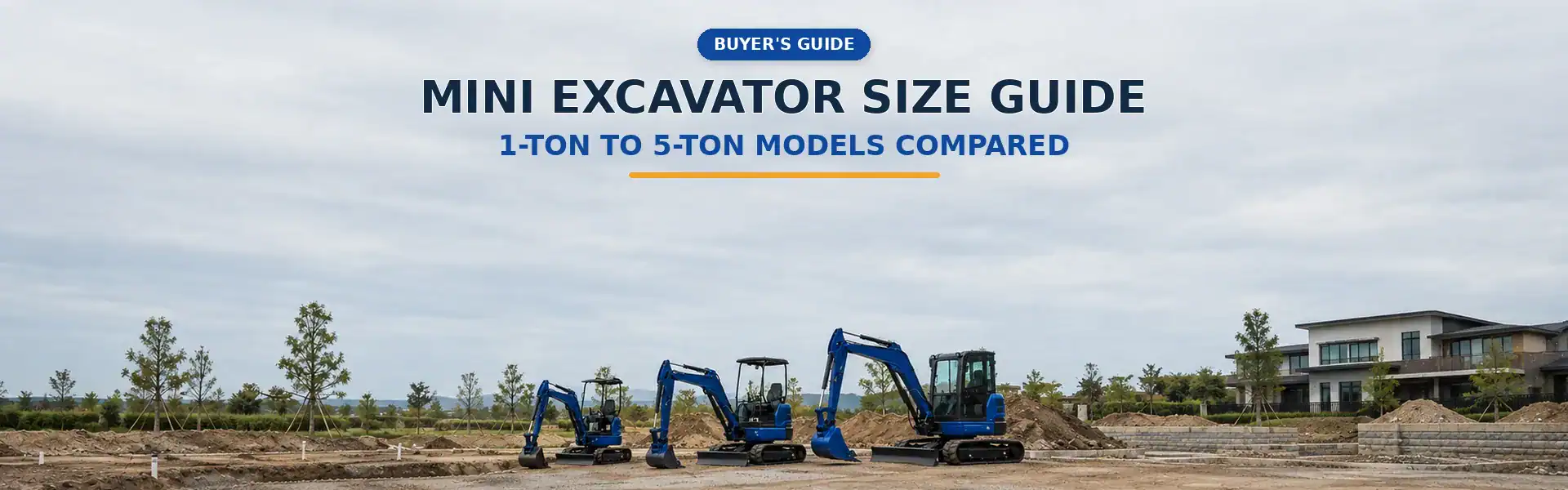
Puntos clave
- Choose the smallest mini excavator that can meet the required digging depth, lifting, attachment and production targets while fitting the site's access and transport limits. A 1-ton model prioritizes restricted access; 2–3 ton machines provide a practical balance for general compact work; and 4–5 ton models suit deeper, heavier or higher-volume applications. Always compare the exact width, working range, hydraulic configuration, delivered weight and load information.
Tonnage is only a starting point. Two excavators in the same weight class can have different digging depths, widths, tail-swing envelopes, hydraulic systems and bucket sizes. Buyers should compare the exact configuration rather than assume that a heavier model is automatically deeper, faster or suitable for every attachment.
What Does Mini Excavator Size Mean?
Mini excavator size is normally discussed by operating-weight class. Operating weight is more useful than a model name because it affects stability, ground pressure, transport and the type of work the machine can reasonably support. However, the published value must be read carefully. A canopy or cab, bucket, quick coupler, additional counterweight, steel tracks and other options can change the delivered machine’s actual weight.
Weight class also does not define performance by itself. Maximum digging depth depends on the boom, arm and machine geometry. Practical production depends on soil, bucket width, bucket capacity, hydraulic response, operator technique and where excavated material must be placed. Lifting ability depends on load position, working radius, blade position, undercarriage orientation and the manufacturer’s load chart. This is why a buyer should use tonnage to create a shortlist, then verify the specifications that control the real job.
1-Ton to 5-Ton Mini Excavator Comparison
The table below combines selection guidance with verified Anxing model data. The figures describe the listed models and configurations; they are not universal specifications for every excavator in that tonnage class.
| Size example | Verified operating weight | Verified maximum digging depth | Verified overall width | Typical selection priority | Main limitation to check |
|---|---|---|---|---|---|
| AX-10, 1-ton class | 1,000 kg | 1,200 mm | Confirm for the quoted configuration | Very restricted access and light, shallow excavation | Reach, stability and production rate |
| AX-15, 1.5-ton class | 1 500 kg | 1,650 mm | 1,000 mm | Compact landscaping and property work with more capability than the smallest class | Required depth and attachment demand |
| AX-20, 2-ton class | 2 000 kg | 2,150–2,200 mm | 1,100–1,150 mm | Utility trenches, landscaping and compact construction access | Configuration-specific dimensions and hydraulic requirements |
| AX-30, 3-ton class | 3 000 kg | 2 350 mm | 1 300 mm | General compact excavation with a stronger balance of size and output | Transport weight, access width and load-chart requirements |
| AX-40, 4-ton class | 4 000 kg | 2,724–3,530 mm | 1,500–1,550 mm | Deeper trenching, site preparation and more demanding attachment work | Exact boom, engine and overall-dimension configuration |
| AX-50, 5-ton class | 5 000 kg | 2,754–3,208 mm | 1,700–1,720 mm | Higher-volume excavation, heavier site work and larger buckets | Site access, ground support and hauling capacity |
The non-linear digging-depth figures are important. The listed AX-40 configurations reach as deep as 3,530 mm, while the listed AX-50 configurations reach 2,754–3,208 mm. The 5-ton model offers a larger 0.10–0.11 m³ bucket range than the AX-40’s 0.075–0.10 m³ range, but it is not automatically the deeper machine. The correct comparison depends on whether the job is limited by depth, material moved per cycle, lifting, attachment work or site access.
When a 1-Ton Mini Excavator Makes Sense
A 1-ton excavator is primarily an access solution. It is relevant when the route is narrow, the working area is small, or reducing machine weight matters more than maximizing production. Typical tasks include shallow service trenches, garden preparation, fence and planting work, light property maintenance and excavation around existing structures where space is the dominant constraint.
The tradeoff is limited working envelope and stability. A small excavator generally uses a smaller bucket and moves less material each cycle. It can take longer to complete a trench that a larger machine could finish efficiently. Lifting, grading on uneven ground and running demanding attachments also require careful verification. If the project includes compacted soil, rock, deep utilities or frequent loading into a high-sided vehicle, access alone should not decide the purchase.
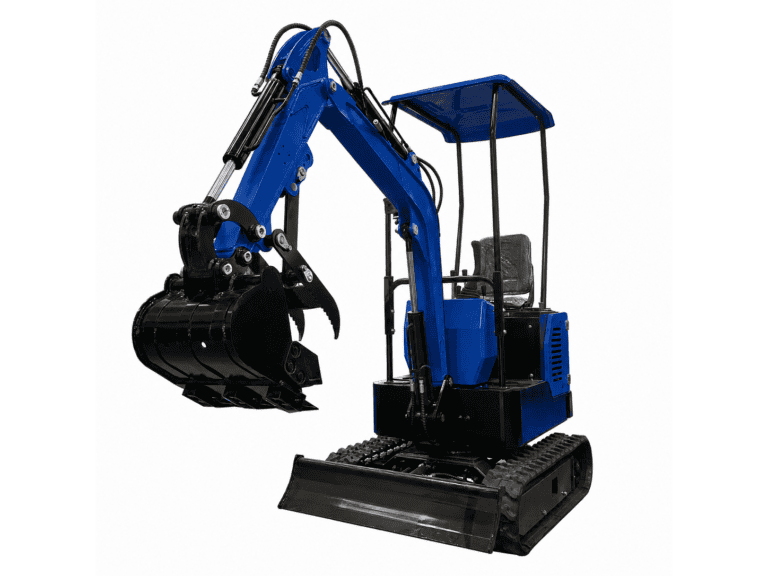
Within Anxing’s 1–1.8 ton mini excavator range, the AX-10 is listed at 1,000 kg with a 1,200 mm maximum digging depth. Moving to the AX-15 increases operating weight to 1,500 kg and listed digging depth to 1,650 mm while retaining a 1,000 mm overall width. That comparison shows why some buyers who initially request “one ton” may be better served by a 1.5-ton model if the access route can accept it.
Why Buyers Move Up to the 2-Ton Class
A 2-ton excavator often suits contractors who still need compact dimensions but cannot accept the production and reach limits of the smallest class. It is a practical starting point for utility work, drainage, residential trenching, landscaping, small foundations and general site support. The extra mass can improve stability, while the larger working envelope makes it easier to reach across a trench or place spoil away from the excavation edge.
The AX-20 is listed at 2,000 kg, with a 2,150–2,200 mm maximum digging depth and a 1,100–1,150 mm overall width depending on configuration. Those figures should be checked against the narrowest gate, the clearance needed to rotate, and the required trench depth. A machine that passes through the entrance may still lack room for its counterweight, boom swing and spoil pile.
The 2-ton class can also be attractive to equipment dealers because it covers a broader application range than a micro excavator. Before choosing inventory, however, confirm which engines, tracks, buckets, auxiliary lines and couplers are included. A size class is not a complete dealer specification.
Why the 3-Ton Class Is a General-Purpose Choice
Three-ton mini excavators sit between restricted-access machines and the heavier compact construction class. They can suit general trenching, residential construction, hardscaping, drainage, grading and site preparation where both maneuverability and useful production matter. Buyers commonly consider this class when one machine must handle several tasks rather than a single light application.
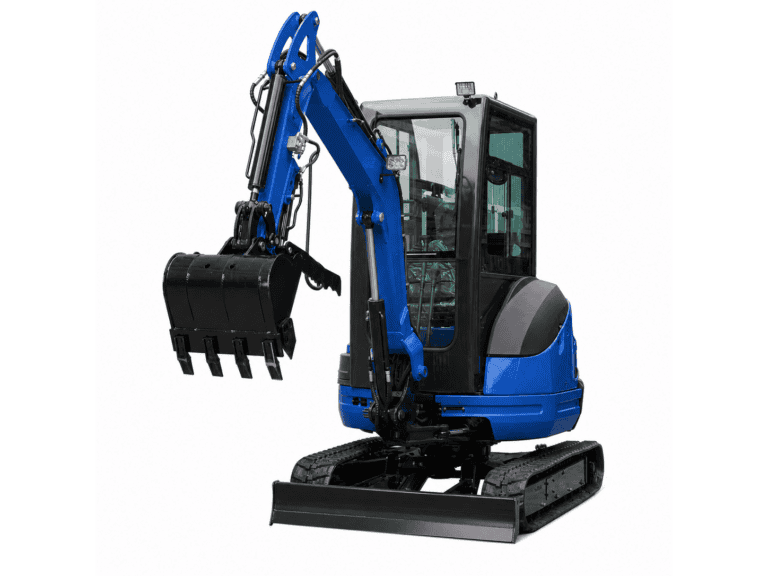
Anxing lists the AX-30 at 3,000 kg, 1,300 mm overall width, 2,350 mm maximum digging depth and 0.054 m³ bucket capacity. These values provide a more capable envelope than the listed AX-20, but the additional width and weight must fit the site and transport arrangement. The machine also uses a different listed engine and power configuration, so maintenance planning and destination requirements should be reviewed at the model level.
A 3-ton excavator is not automatically the best compromise. If most jobs involve only narrow residential access, the extra capacity may remain unused while access becomes harder. If daily work includes deep trenching, larger buckets, heavy breakers or lifting pipe at reach, a 4-ton or 5-ton configuration may be more productive and stable.
When to Choose a 4-Ton or 5-Ton Mini Excavator
The 4-ton and 5-ton classes are appropriate when excavation output, working range, bucket size and stability take priority over fitting through the smallest entrance. Applications can include deeper utility trenches, larger landscaping projects, site preparation, road and drainage work, light demolition and material handling with an approved lifting configuration.
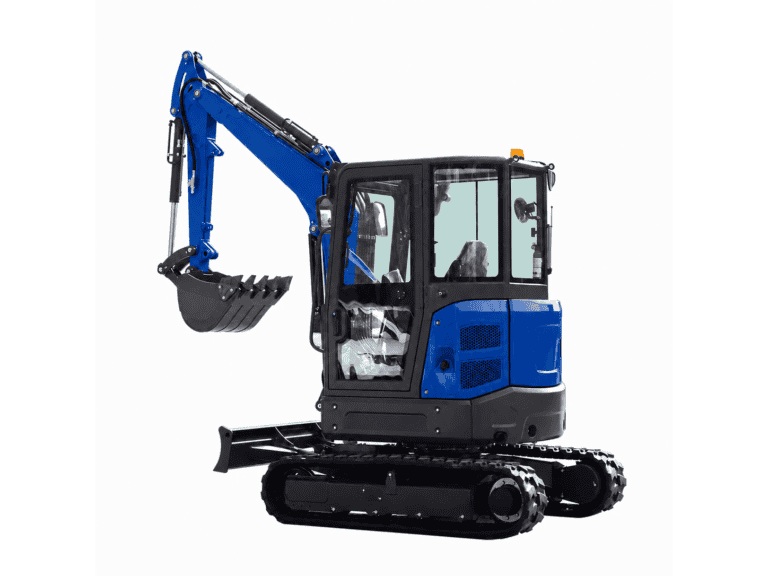
El Anxing 3.5–5 ton mini excavator range illustrates the importance of configuration. The AX-40 is listed with 4,000 kg operating weight, 1,500–1,550 mm width, 0.075–0.10 m³ bucket capacity and 2,724–3,530 mm maximum digging depth. The AX-50 is listed at 5,000 kg, 1,700–1,720 mm width, 0.10–0.11 m³ bucket capacity and 2,754–3,208 mm digging depth.
Choose between them by the bottleneck. If maximum depth is critical, compare the exact boom and arm combination. If production in bulk soil is the priority, compare bucket capacity, cycle requirements and truck-loading height. If attachments are central to the business, verify the tool’s mass and hydraulic demand against the excavator’s approved limits. If the machine moves between projects frequently, include the total transport package before choosing the heavier class.
Seven Factors That Should Decide the Size
1. Site access and working envelope
Measure the narrowest gate, doorway and passage, plus overhead obstructions. Then map the space available for upperstructure rotation, boom swing, blade use and spoil placement. Overall width is not the complete working envelope. Also check whether the undercarriage width is fixed or adjustable on the quoted model and whether the stated transport width changes with the blade or track configuration.
2. Required digging depth, reach and dumping height
Specify the finished trench depth, not a rough project description. Allow for machine positioning, grade changes and a reasonable working margin. Horizontal reach matters when the excavator cannot sit directly beside the trench. Dumping height matters when loading trucks or placing spoil behind a barrier. Ask for the full working-range drawing for the exact arm and bucket.
3. Soil and material condition
Loose topsoil, wet clay, compacted fill and broken rock create different bucket and digging demands. A small machine may reach the target depth but still produce too slowly in difficult material. Tell the supplier whether the machine will trench, grade, load, break, drill or handle objects, and identify the dominant material.
4. Lifting requirement
Do not estimate lifting capacity from operating weight or bucket force. State the maximum load, lifting radius, height or depth, and whether the lift occurs over the front or side. The selected configuration must be checked against its load chart, approved lifting point and local operating requirements. Attachments and couplers add weight at the end of the working equipment and reduce the remaining load available for the object.
5. Attachments and auxiliary hydraulics
A breaker, auger, grapple, thumb, compactor or tilt attachment must match the carrier. Verify attachment weight, required hydraulic flow and pressure, auxiliary line arrangement, return line, coupler dimensions and electrical controls where applicable. Buying a larger excavator does not solve an incompatible hydraulic circuit.
6. Ground conditions and stability
Consider slope, soft ground, finished surfaces, underground structures and allowable ground loading. Rubber tracks can suit many finished or mixed sites, while track and shoe choices for abrasive or demanding terrain should be confirmed with the supplier. A heavier machine may improve stability but can increase surface disturbance and may be unsuitable for weak ground, slabs or landscaped areas.
7. Transport and delivery constraints
Check the delivered machine’s actual weight and transport dimensions with the selected cab or canopy, bucket, coupler, tracks, counterweight and attachments. The towing vehicle, trailer, ramps, tie-down arrangement and local road limits must be evaluated as one system. For imported equipment, also confirm packing method, shipping dimensions, unloading plan and whether attachments ship installed or separately.
A Practical Mini Excavator Sizing Workflow
- Define the hardest recurring job. Record the deepest excavation, toughest material, largest bucket or attachment demand, and any required lift. Do not size the machine only for the easiest task.
- Set the access envelope. Measure width, height, turning space and tail-swing clearance along the complete route from unloading point to work area.
- Set the performance minimum. Specify digging depth, reach, dumping height and expected material volume or work rate. Treat catalog maxima as limits, not as the normal position for every cycle.
- List every attachment. Provide tool weight, hydraulic flow and pressure requirements, coupler interface and expected usage. Identify the attachment that creates the highest demand.
- Check ground and stability. Describe soil, slope, trench edges, finished surfaces and any ground-bearing limits. Include lifting requirements separately from digging.
- Build the transport package. Add the machine, fuel, operator-protection configuration, coupler, bucket and transported attachments. Compare the complete package with the planned transport and unloading method.
- Shortlist two adjacent sizes. Compare, for example, 2 tons against 3 tons or 4 tons against 5 tons. Identify what the heavier machine improves and what access or transport flexibility it removes.
- Confirm the final configuration. Request a model-specific specification sheet, working-range drawing, load information and hydraulic details. Make sure the quotation identifies the engine, tracks, boom and arm, bucket, coupler, attachments and included spare parts.
This process prevents a common mistake: choosing the lowest-priced machine that appears to reach the required depth. A machine can meet one headline figure and still be wrong because it cannot enter the site, lift the required object, run the attachment, load the receiving vehicle or travel legally with the available transport system.
How to Shortlist the Anxing Mini Excavator Range
Empieza con el Anxing mini excavator category to see the three operating-weight groups. Use the 1–1.8 ton range when compact access is the first filter. Move to the 2–3 ton mini excavator range when the project needs more reach and general-purpose capability without moving immediately to a wider 4- or 5-ton machine. Compare the 3.5–5 ton range when bucket size, deeper configurations and heavier site work determine productivity.
Within each range, compare exact models rather than selecting the upper end automatically. The AX-15 may be a stronger access-focused choice than the AX-10 where a 1,000 mm width is acceptable and additional digging depth is required. The AX-30 provides more weight and width than the AX-20, which may benefit general construction but changes transport and access. The AX-40 and AX-50 require a configuration-level comparison because their digging-depth ranges overlap and the larger machine’s clearest advantage may be bucket size and working stability rather than maximum depth.
For mixed fleets or project planning, Anxing’s construction and landscaping equipment solution can help connect the excavator choice with the wider work sequence. Final model suitability still depends on the site data, attachments and destination requirements supplied with the inquiry.
Common Mini Excavator Size Mistakes
Choosing by tonnage alone
The weight class does not guarantee a particular digging depth, width, lift capacity or hydraulic circuit. Compare the exact data sheet and working-range drawing.
Using maximum digging depth as normal working depth
Maximum depth occurs at a specific geometry and does not describe productivity across the whole trench. Select enough working margin for positioning, grade changes and efficient cycles.
Checking the gate but not the swing area
Access width only confirms that the machine can enter. The excavator also needs room to rotate, place spoil, use the blade and keep appropriate clearance from structures and people.
Ordering attachments after the carrier
The attachment may require hydraulic flow, pressure, controls, a coupler and carrier stability that the selected machine does not provide. Define the attachment package before approving the base excavator.
Ignoring delivered and transport weight
The class label may not include every installed option and transported tool. Verify actual configuration weight and dimensions before selecting the truck, trailer, container loading plan or unloading equipment.
What to Include in a Mini Excavator RFQ
A useful quotation request should let the supplier check the application, not merely return a price for a tonnage label. Send:
- main applications and material or soil conditions;
- required digging depth, horizontal reach and dumping height;
- narrowest access width, overhead clearance and working-space limits;
- maximum lifting load, radius and direction, if lifting is required;
- required buckets, breaker, auger, grapple, thumb, coupler or other attachments;
- hydraulic flow and pressure requirements for buyer-supplied tools;
- ground conditions, slopes and finished-surface restrictions;
- expected daily hours and typical work cycle;
- preferred engine, cab or canopy, tracks and control configuration;
- transport limits, quantity, destination country and destination port or city;
- required manuals, markings, inspection, spare parts and destination-specific documents to confirm.
Photos, a dimensioned access sketch and attachment data sheets are especially useful. With these inputs, Anxing can compare adjacent size classes and identify whether the application is controlled by compact access, digging performance, attachment compatibility, stability or transport. The result is a configuration-based comparison rather than a generic 1-ton, 3-ton or 5-ton price list.